
Meta Description
This article explains the complete internal structure of floor-standing LiFePO₄ batteries, including cell arrangement, BMS, enclosure, and safety design for energy storage systems.
Introduction
Floor-standing LiFePO₄ batteries are widely used in residential, commercial, and light-industrial energy storage systems due to their large capacity, modular expandability, and high safety level. Unlike wall-mounted or rack-mounted battery units, floor-standing batteries are designed to house more internal components within a single enclosure.
Understanding the internal structure of a floor-standing LiFePO₄ battery is critical for system integrators, distributors, and project engineers. This article provides a complete breakdown of the internal architecture and explains how each component contributes to performance, safety, and long-term reliability.
1. Core Structural Layers Inside a Floor-Standing LiFePO₄ Battery
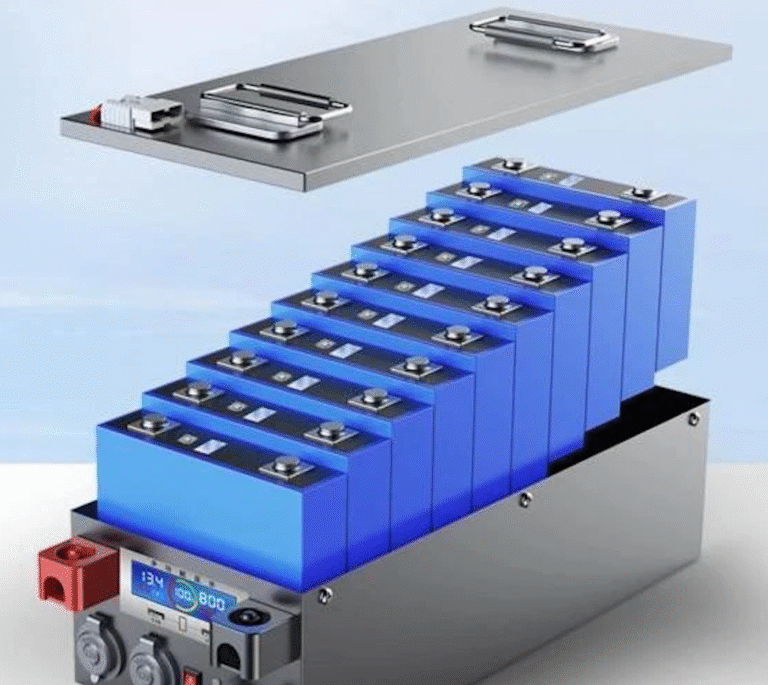
A typical floor-standing LiFePO₄ battery consists of the following internal layers:
- Battery Cell Module Layer
- Battery Management System (BMS) Layer
- Electrical Protection and Power Distribution Layer
- Thermal Management Layer
- Mechanical Enclosure and Structural Reinforcement
Each layer is physically and functionally isolated to prevent cascading failures.
2. LiFePO₄ Cell Arrangement and Module Design
Most floor-standing batteries use either:
- Prismatic LiFePO₄ cells (100Ah–314Ah)
- Large pouch cells (less common in floor units)
Cells are arranged in series-parallel configurations to achieve nominal voltages such as:
- 48V (15S or 16S)
- 51.2V (16S)
- High-voltage stackable designs (96V–400V internally modular)
Cells are mounted on insulated brackets or aluminum frames to prevent vibration damage and ensure uniform pressure distribution.
Key design considerations:
- Cell spacing for heat dissipation
- Compression force control to avoid cell swelling
- Individual cell insulation sleeves
3. Battery Management System (BMS) Architecture
The BMS is usually installed on an isolated internal plate above or beside the battery modules.
Typical BMS functions include:
- Cell voltage monitoring
- Temperature sensing (multiple NTC sensors)
- Active or passive balancing
- Over-current and short-circuit protection
- CAN / RS485 / RS232 communication
In floor-standing batteries, distributed BMS architecture is often used:
- Slave BMS boards on each module
- One master BMS for system coordination
This structure improves scalability and fault isolation.
4. Electrical Protection Components Inside the Battery
Floor-standing batteries integrate multiple protection elements:
- DC circuit breakers or fuses
- Pre-charge resistors
- High-current copper busbars
- Emergency manual disconnects
All power paths are designed with short current loops to reduce resistance and electromagnetic interference (EMI).
5. Thermal Design and Heat Dissipation Strategy
Unlike compact wall-mounted units, floor-standing batteries rely primarily on:
- Natural convection airflow
- Internal air channels
- Aluminum heat-spreading plates
Some high-power models include:
- Low-noise DC fans
- Intelligent fan control via BMS
Liquid cooling is rare but emerging in high-energy commercial models.
6. Mechanical Enclosure and Structural Reinforcement
The enclosure is typically made of:
- Powder-coated steel (SPCC or galvanized steel)
- Internal reinforced beams for load distribution
Key features include:
- Anti-tilt base design
- IP20–IP54 protection
- Separate compartments for electronics and cells
This structure ensures long-term mechanical stability under heavy battery weight.
Conclusion
The internal structure of a floor-standing LiFePO₄ battery is engineered to balance energy density, safety, and serviceability. Each layer—from cell arrangement to BMS and enclosure—plays a critical role in system performance.
For energy storage projects, selecting a battery with a well-designed internal architecture directly impacts reliability, lifecycle cost, and compliance with international standards.
SEO Keywords:
floor-standing LiFePO₄ battery, lithium battery internal structure, energy storage battery design, LiFePO₄ battery BMS