
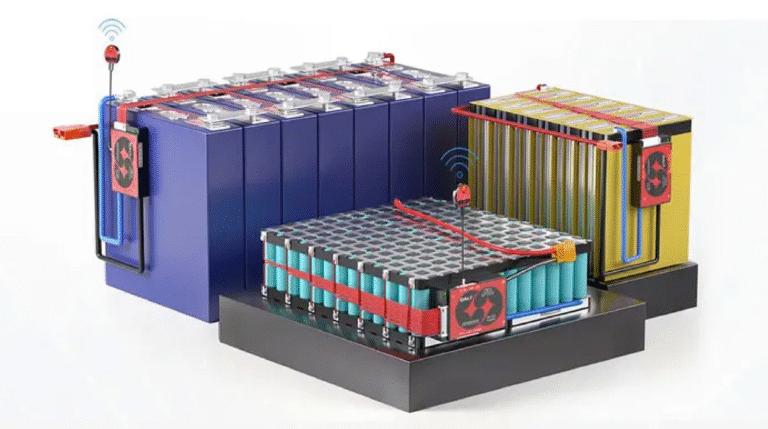
🔋 Introduction
A high-quality battery is not just about cells—it’s also about the Battery Management System (BMS).
In fact, a poor BMS can reduce battery life dramatically, even if the cells are excellent.
📌 What Is a BMS?
A Battery Management System (BMS) is the “brain” of a lithium battery that monitors and controls:
- Voltage
- Current
- Temperature
- State of charge (SOC)
🔍 How BMS Extends Cycle Life
1️⃣ Overcharge Protection
- Prevents voltage from exceeding safe limits
👉 Avoids accelerated degradation
2️⃣ Over-Discharge Protection
- Stops battery from deep discharge
👉 Protects internal structure
3️⃣ Cell Balancing
- Keeps all cells at equal voltage
👉 Prevents weak-cell failure
4️⃣ Temperature Protection
- Cuts off operation in extreme heat or cold
👉 Avoids thermal damage
5️⃣ Current Control
- Limits excessive charge/discharge current
👉 Reduces stress on cells
📊 Impact on Cycle Life
Without BMS:
- Uneven cells
- Overcharge damage
- Short lifespan
With high-quality BMS:
👉 Lifespan can increase by 30–50%
⚠️ Key Risk in the Market
Not all BMS are equal:
- Low-cost BMS → minimal protection
- Advanced BMS → intelligent control + communication
💡 What to Look for in a BMS
- Active/passive balancing
- Temperature sensors
- Communication protocols (RS485, CAN)
- Reliable cutoff protection