
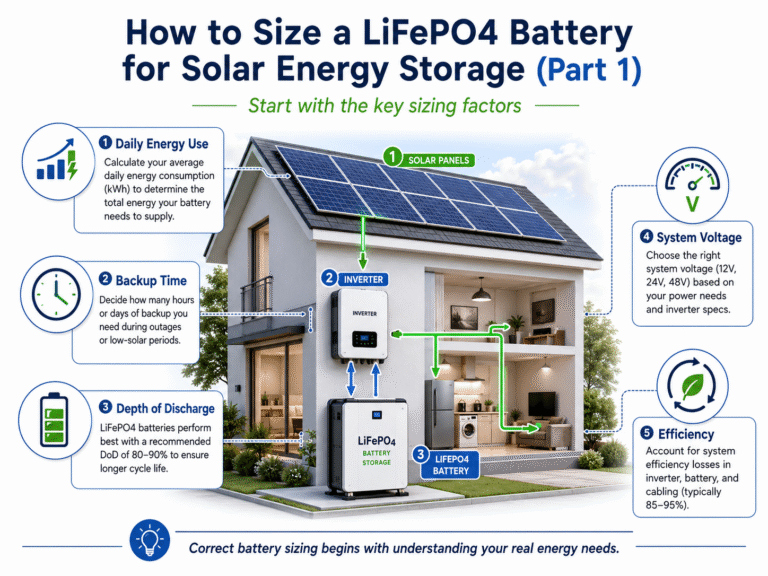
Introduction
One of the biggest mistakes in solar energy storage projects is selecting a battery based only on price or advertised capacity.
Many first-time buyers ask questions such as:
- Should I buy a 5kWh battery?
- Is a 10kWh battery enough?
- Do I need 15kWh or 20kWh?
- How many batteries should I install?
Unfortunately, there is no universal answer.
The correct battery size depends on your energy consumption, backup objectives, solar generation, inverter capacity, local climate, and future expansion plans.
Oversizing a battery increases project cost unnecessarily, while undersizing it may leave users without sufficient backup power during outages.
Professional battery sizing is therefore one of the most important steps in designing a reliable and cost-effective Energy Storage System (ESS).
This chapter explains the engineering methodology used by professional system designers to determine the appropriate battery capacity for residential, commercial, telecom, and off-grid applications.
Step 1 — Define the Project Objective
Before calculating battery capacity, the designer must clearly understand why the battery is being installed.
Different objectives require very different battery sizes.
For example:
Self-Consumption Optimization
The battery stores excess solar energy during the day and supplies electricity during the evening.
Typical backup duration:
- 4–8 hours
Emergency Backup
The battery operates only during utility power outages.
Typical design focuses on:
- Critical loads
- Limited backup duration
- High reliability
Off-Grid Operation
The battery becomes the primary energy source during nighttime and cloudy weather.
This requires significantly larger battery capacity.
Peak Shaving
Commercial facilities may install batteries primarily to reduce demand charges.
Battery capacity depends on:
- Peak demand
- Utility tariff structure
- Load profile
Time-of-Use Optimization
In regions with variable electricity pricing, batteries may charge during low-cost periods and discharge during expensive periods.
Sizing depends on the daily tariff schedule and expected energy arbitrage.
Step 2 — Perform an Energy Audit
Professional system design always begins with an energy audit.
Instead of guessing battery size, engineers first determine how much electricity is actually consumed.
The most accurate method is to analyze utility bills over the previous 12 months.
This provides information about:
- Average daily consumption
- Seasonal variation
- Peak demand
- Load growth trends
Where utility data is unavailable, loads can be estimated by listing individual appliances.
Appliance-Based Energy Audit
The following example illustrates a typical residential energy audit.
| Appliance | Power | Daily Use | Daily Energy |
|---|---|---|---|
| LED Lighting | 120W | 6 h | 0.72 kWh |
| Refrigerator | 180W | 10 h (cycling) | 1.80 kWh |
| Television | 120W | 4 h | 0.48 kWh |
| Wi-Fi Router | 20W | 24 h | 0.48 kWh |
| Laptop | 80W | 5 h | 0.40 kWh |
| Washing Machine | 500W | 1 h | 0.50 kWh |
| Air Conditioner | 1500W | 5 h | 7.50 kWh |
Estimated Daily Consumption:
≈ 11.88 kWh
This value becomes the foundation for battery sizing.
Step 3 — Separate Essential and Non-Essential Loads
Not every appliance must remain powered during a grid outage.
Professional ESS design usually divides loads into two categories.
Essential Loads
These are devices that should continue operating during a blackout.
Examples include:
- Lighting
- Refrigerator
- Internet equipment
- Security systems
- Medical devices
- Communication equipment
Non-Essential Loads
These can usually be turned off temporarily.
Examples include:
- Electric water heaters
- Swimming pool pumps
- Electric ovens
- Clothes dryers
- EV charging
- Large HVAC systems (depending on project goals)
Designing backup power only for essential loads often reduces battery cost substantially.
Step 4 — Calculate Daily Energy Requirement
Once the essential loads have been identified, calculate their total daily energy consumption.
Example:
| Essential Load | Daily Energy |
| Lighting | 0.72 kWh |
| Refrigerator | 1.80 kWh |
| Wi-Fi | 0.48 kWh |
| Television | 0.48 kWh |
| Laptop | 0.40 kWh |
Total Essential Energy
≈ 3.88 kWh/day
If the goal is emergency backup only, this value—not the entire household consumption—should be used as the basis for battery sizing.
Step 5 — Determine Required Backup Time
The next question is:
How long should the battery provide power?
Different users have different expectations.
Short Backup
4–6 hours
Suitable for areas with stable utility service.
Overnight Backup
10–14 hours
Common for residential solar systems.
One-Day Backup
24 hours
Provides security during extended outages.
Multi-Day Autonomy
48–72 hours
Typically used in off-grid systems and remote installations.
Example Calculation
Assume the essential loads require:
4 kWh/day
The homeowner wants:
One full day of backup.
Required usable battery energy:
≈ 4 kWh
Adding a design reserve of approximately 20% to accommodate aging and unexpected load increases:
Required battery capacity:
≈ 4.8–5 kWh
A 51.2V 100Ah LiFePO4 battery (5.12kWh nominal) would generally be an appropriate starting point for this application.
Step 6 — Consider Future Expansion
One of the biggest design mistakes is sizing the battery only for today’s requirements.
Electricity demand often increases over time due to:
- Additional family members
- New appliances
- Electric vehicle charging
- Heat pumps
- Air conditioning upgrades
- Home office equipment
Choosing a modular battery system that supports parallel expansion allows homeowners to increase storage capacity without replacing the original installation.
This flexibility can significantly reduce future upgrade costs.
Engineering Insight
Many residential projects are oversized because designers focus on maximum appliance power rather than actual energy consumption.
For example, a homeowner may own:
- A 2.5kW air conditioner
- A 2kW oven
- A 2kW kettle
Although the combined power exceeds 6kW, these appliances rarely operate simultaneously for extended periods.
Professional system design therefore evaluates:
- Daily energy usage (kWh)
- Coincidence factor
- Load diversity
- User behavior
rather than simply adding the nameplate ratings of every appliance.
This results in a more accurate battery size, lower project cost, and better return on investment.