
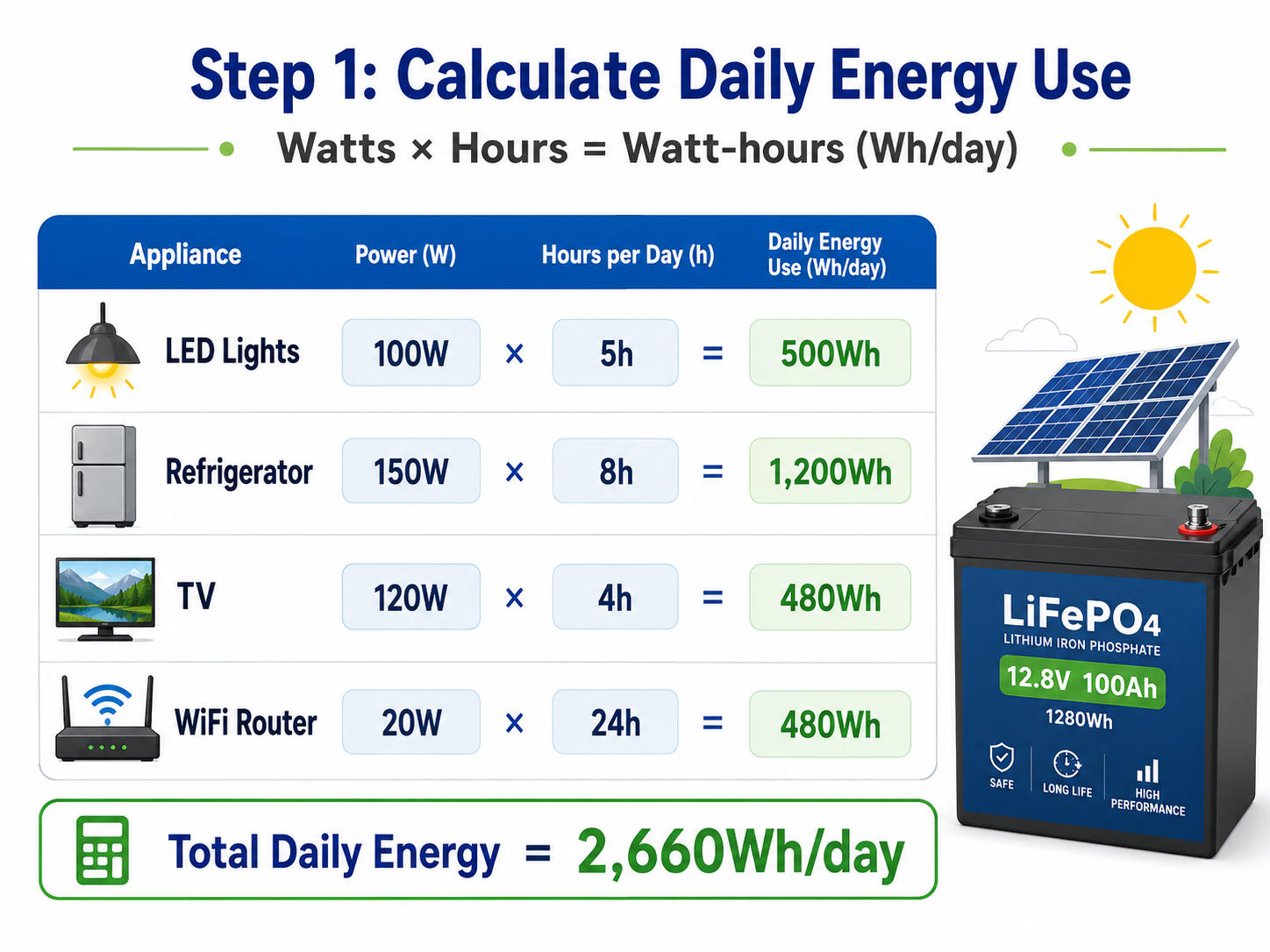
The Core Battery Sizing Formula
A simplified sizing equation for residential and commercial ESS projects is:
Where:
- Daily Energy Demand = required backup energy (kWh)
- DOD = allowable Depth of Discharge
- System Efficiency = combined battery and inverter efficiency
This formula provides a practical starting point for battery selection.
Example 1 – Residential Backup System
Assume:
- Daily essential load: 8 kWh
- Recommended DOD: 95%
- Overall system efficiency: 96%
Calculation:
Recommended battery size:
10 kWh class
This provides operational margin while allowing for future battery aging.
Example 2 – Full-Day Home Backup
Assume:
Daily household consumption:
15 kWh
Battery efficiency:
96%
Recommended DOD:
90%
Calculation:
Recommended configuration:
- 1 × 16.08 kWh battery (if partial reserve is acceptable), or
- 2 × 10.24 kWh batteries for greater flexibility and future expansion.
Why Engineers Add a Safety Margin
Real-world energy consumption is rarely constant.
Unexpected factors include:
- Additional visitors
- Seasonal air conditioning
- Electric heating
- Extended power outages
- Battery aging
- Cloudy weather reducing solar generation
For this reason, professional designers normally include a reserve capacity.
Typical recommendations are:
| Application | Suggested Design Margin |
|---|---|
| Residential ESS | 15–25% |
| Commercial ESS | 20–30% |
| Telecom Backup | 25–35% |
| Off-Grid Systems | 30–50% |
A modest reserve improves reliability without significantly increasing project cost.
Step 7 – Check Inverter Compatibility
Battery sizing cannot be performed independently of the inverter.
The inverter determines:
- Maximum charging current
- Maximum discharge current
- Battery voltage range
- Communication protocol
- Supported battery capacity
For example, a hybrid inverter may support:
- Nominal battery voltage: 48V
- Maximum charge current: 100A
- CAN Bus communication
The selected battery must operate within these parameters.
Compatibility should always be confirmed before procurement.
Step 8 – Verify Charge and Discharge Current
Battery capacity alone does not determine whether a system can support the required load.
Current capability is equally important.
Example:
Battery:
51.2V
100Ah
Maximum continuous discharge:
100A
Maximum continuous power:
Therefore, although the battery stores 5.12 kWh, it should not be expected to continuously supply loads beyond its rated output capability.
Large loads may require:
- Higher-capacity batteries
- Multiple batteries in parallel
- Higher-voltage battery systems
Step 9 – Parallel Expansion
One of the greatest advantages of modern LiFePO4 ESS batteries is modular expansion.
Instead of purchasing one oversized battery, installers often begin with a smaller system that can be expanded later.
Example:
| Configuration | Total Energy |
| 1 × 51.2V100Ah | 5.12 kWh |
| 2 × 51.2V100Ah | 10.24 kWh |
| 3 × 51.2V100Ah | 15.36 kWh |
| 4 × 51.2V100Ah | 20.48 kWh |
This approach reduces initial investment while allowing future growth.
Step 10 – Consider Seasonal Solar Production
Solar generation varies throughout the year.
Winter production may be significantly lower than summer production.
Factors affecting seasonal generation include:
- Day length
- Solar irradiance
- Cloud cover
- Panel orientation
- Snow accumulation (where applicable)
Professional battery sizing should therefore consider the lowest expected solar production period, not only annual averages.
HIZN Engineer’s Design Example
Project Overview
Location: Southern Germany
System Type: Residential Hybrid Solar
Solar Array: 10 kW
Average Daily Consumption: 18 kWh
Critical Backup Requirement: Overnight operation
Design Process
- Essential overnight load identified at approximately 11 kWh.
- DOD assumed at 95%.
- System efficiency estimated at 96%.
- Added a 20% engineering reserve for future EV charging and winter performance.
Recommended Battery Configuration
- 2 × 51.2V 200Ah LiFePO4 batteries
- Total nominal capacity: 20.48 kWh
This configuration provides:
- Overnight autonomy under typical conditions
- Reserve capacity during periods of reduced solar generation
- Expansion capability for future household demand
Common Design Mistakes
Mistake 1 – Choosing the Cheapest Battery
Initial purchase price does not reflect lifetime operating cost.
A lower-cost battery with fewer cycles may require replacement much sooner.
Mistake 2 – Ignoring Usable Capacity
Comparing batteries using only rated kWh can lead to undersized systems.
Always evaluate usable energy after accounting for DOD and efficiency.
Mistake 3 – Oversizing the Battery
Larger is not always better.
Excessive battery capacity increases project cost and may lengthen the payback period.
Sizing should be based on actual energy requirements.
Mistake 4 – Forgetting Future Expansion
Many households eventually add:
- Electric vehicles
- Heat pumps
- Air conditioning
- Additional family members
Choosing a modular battery system simplifies future upgrades.
Mistake 5 – Ignoring Local Climate
Battery sizing for Northern Europe differs from sizing for tropical regions.
Solar production, temperature, and seasonal variation all influence system design.
Engineering Insight
Professional battery sizing is fundamentally different from simply selecting the largest available battery.
The objective is to optimize the relationship between:
- Investment cost
- Backup performance
- Battery lifespan
- Solar utilization
- Future expansion
An appropriately sized battery often delivers a better return on investment than a significantly larger system that remains underutilized for most of its service life.