
Introduction
A LiFePO4 battery that suddenly switches off can be frustrating, especially when it powers a home solar system, telecom station, or off-grid installation.
Many users immediately assume the battery has failed.
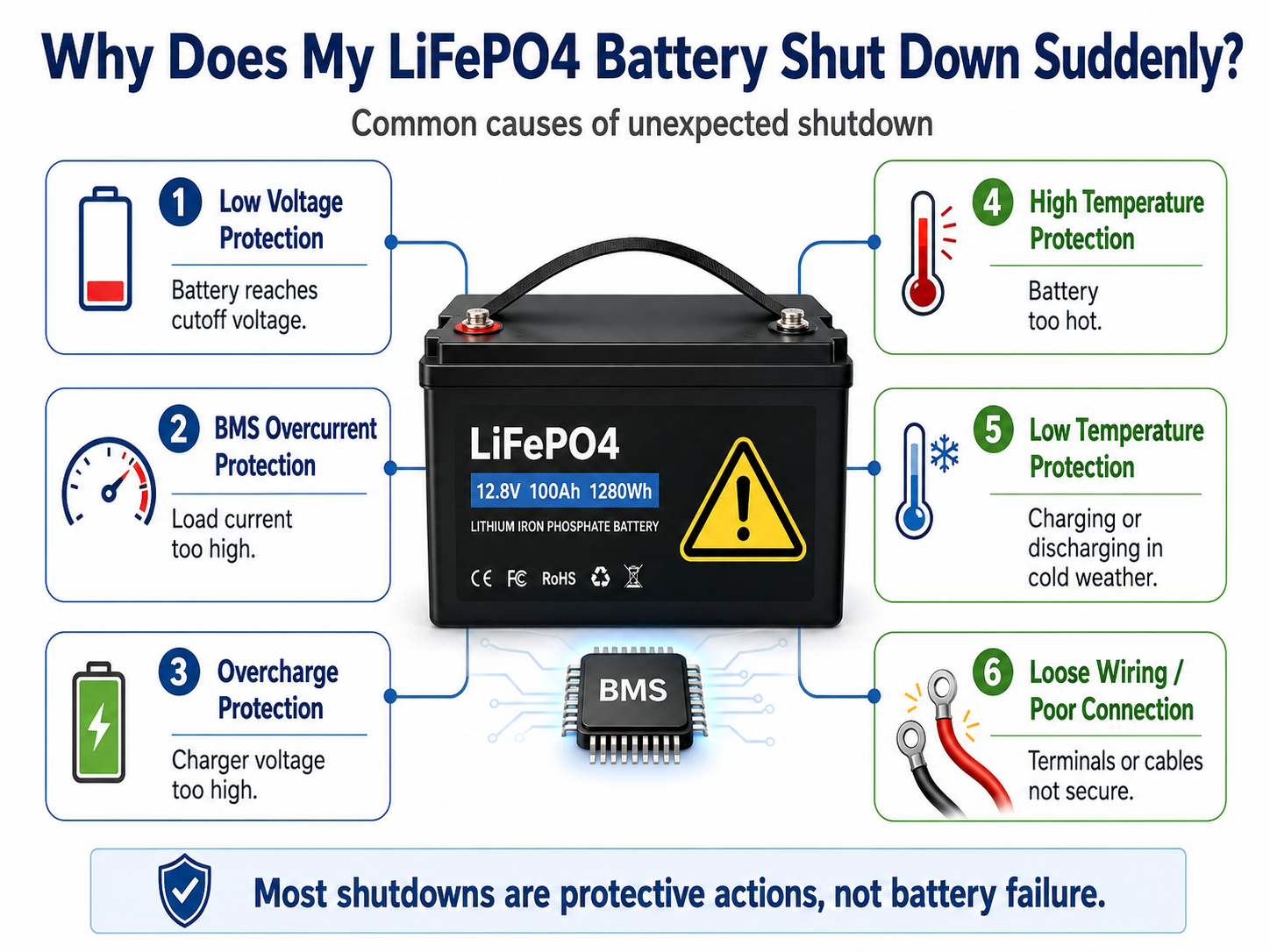
In reality, most unexpected shutdowns are caused by the Battery Management System (BMS) protecting the battery, not by permanent damage.
The BMS is designed to disconnect the battery whenever operating conditions move outside safe limits.
Understanding why this happens can save time, prevent unnecessary battery replacement, and reduce system downtime.
This guide explains the ten most common reasons a LiFePO4 battery shuts down unexpectedly and provides practical solutions for each situation.
1. Low Battery Voltage
The most common cause is over-discharge.
When battery voltage falls below the minimum protection threshold, the BMS disconnects the output to prevent cell damage.
Typical Symptoms
- Battery suddenly powers off
- Inverter displays “Low Battery”
- No DC output
- Battery LEDs may still be active
Solution
- Recharge the battery immediately using the recommended charger or hybrid inverter.
- Check inverter low-voltage cutoff settings.
- Avoid repeatedly discharging the battery to the minimum voltage.
2. Overload
Connecting loads larger than the battery’s continuous discharge capability can trigger BMS protection.
Examples include:
- Large air conditioners
- Water pumps
- Air compressors
- Electric heaters
Solution
Verify:
- Continuous discharge current
- Peak discharge current
- Inverter power rating
- Actual appliance startup current
If necessary, use a larger battery bank or connect batteries in parallel according to the manufacturer’s guidelines.
3. Short Circuit Protection
A damaged cable or incorrect wiring may create a short circuit.
The BMS disconnects almost instantly to prevent severe damage.
Inspection Checklist
- Check battery terminals.
- Inspect DC cables for damage.
- Verify fuse condition.
- Confirm correct polarity.
Never bypass protective devices when troubleshooting.
4. Battery Temperature Too High
High ambient temperatures are common in the Middle East and Africa.
If internal battery temperature exceeds the protection threshold, charging or discharging may stop automatically.
Common Causes
- Battery installed in direct sunlight
- Poor cabinet ventilation
- Battery located beside high-temperature equipment
Best Practice
Install batteries in shaded, well-ventilated locations and maintain adequate clearance around the enclosure.
5. Low-Temperature Charging Protection
Charging LiFePO4 batteries below the manufacturer’s recommended temperature range may activate BMS protection.
This is more common in mountainous areas or during winter.
Solution
- Move the battery to a warmer environment.
- Use batteries with integrated heating if cold-weather charging is expected.
- Follow the manufacturer’s charging temperature specifications.
6. Incorrect Inverter Settings
Improper inverter parameters are a frequent cause of unexpected shutdowns.
Incorrect settings may include:
- Charging voltage too high
- Low-voltage cutoff too high
- Charging current exceeding recommendations
Always configure the inverter according to the battery manufacturer’s installation manual.
7. Communication Failure Between Battery and Inverter
Many modern ESS systems rely on CAN Bus or RS485 communication.
If communication is interrupted:
- The inverter may stop charging.
- Battery information may disappear.
- Protective shutdowns may occur depending on system design.
Check
- Communication cable
- Connector orientation
- Protocol selection
- Firmware compatibility
8. Loose Battery Connections
Loose terminals increase electrical resistance.
This may result in:
- Localized heating
- Voltage drop
- Intermittent shutdowns
Inspect all DC connections periodically and tighten them to the manufacturer’s specified torque.
9. Battery Capacity Imbalance
In systems with multiple batteries connected in parallel, large differences in State of Charge or battery age can cause abnormal behavior.
Avoid mixing:
- New and old batteries
- Different capacities
- Different battery models
- Different firmware versions
Whenever possible, install identical batteries with similar production dates.
10. BMS Hardware or Firmware Fault
Although uncommon, electronic failures can occur.
Possible signs include:
- No communication
- Persistent alarms
- Failure to recover after charging
- Repeated unexplained shutdowns
If basic troubleshooting does not resolve the issue, contact the manufacturer with:
- Battery serial number
- Alarm codes
- Operating history
- Photos of the installation
Quick Troubleshooting Checklist
Before requesting technical support, verify the following:
- Battery voltage
- State of Charge
- Battery temperature
- Inverter settings
- Communication cable
- DC fuse and breaker
- Terminal tightness
- Load power
- Alarm indicators
A systematic inspection often identifies the cause within a few minutes.
Tips for Customers in Hot Climate Regions
For users in Saudi Arabia, UAE, Oman, Nigeria, Kenya, Tanzania, and other hot regions:
- Avoid installing batteries in direct sunlight.
- Ensure adequate ventilation inside battery cabinets.
- Clean dust from ventilation openings regularly.
- Leave sufficient space around batteries for airflow.
- Monitor battery temperature through the inverter or BMS if available.
These simple measures can significantly improve reliability and service life.
Frequently Asked Questions
Does a shutdown always mean the battery is damaged?
No. In most cases, the BMS is protecting the battery from abnormal operating conditions.
Can I restart the battery myself?
Often yes, after correcting the underlying issue, but always follow the manufacturer’s instructions.
Why does the battery shut down only when the air conditioner starts?
The startup surge current may exceed the battery or inverter’s discharge capability.
Should I bypass the BMS?
No. The BMS is a critical safety component and should never be bypassed.
Conclusion
Unexpected LiFePO4 battery shutdowns are usually symptoms of protection mechanisms rather than battery failure.
By understanding common causes such as low voltage, overload, temperature extremes, inverter settings, and communication issues, users can quickly restore operation and avoid unnecessary downtime.
For installers and distributors, following proper installation practices and verifying system configuration before commissioning remains the best way to prevent unexpected shutdowns and ensure long-term system reliability.