
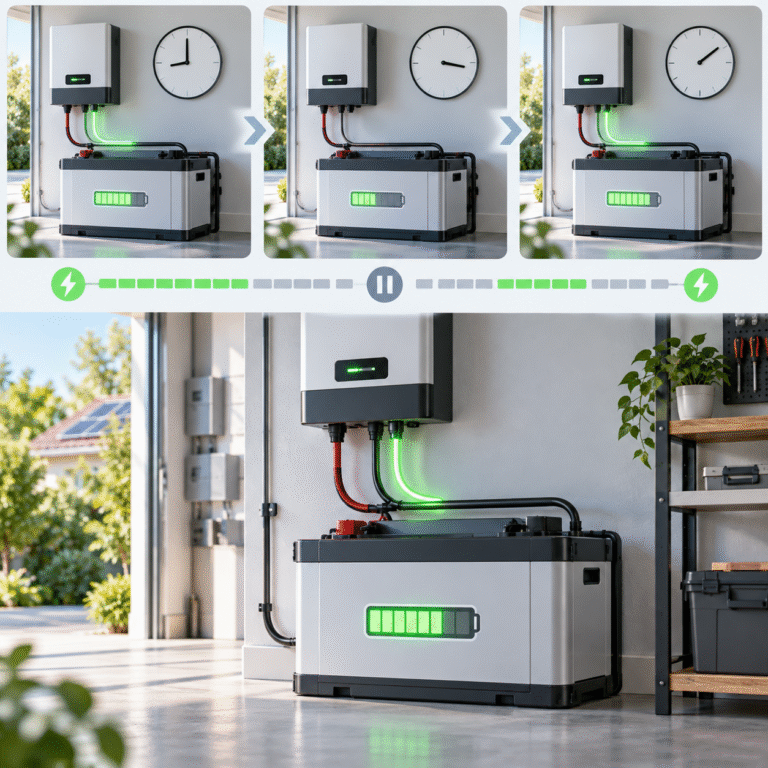
LiFePO4 Does Not Need a Complete Charge Every Time
Imagine a battery starts the morning at: 40% SOC
Solar charges it to: 55%
Clouds reduce PV output.
Later, solar returns and charging continues: 55% → 72%
In the afternoon, the battery eventually reaches: 88%
There is normally no requirement to reset the charging cycle simply because it was interrupted. The battery stores the energy it receives. Charging can continue later when power becomes available again.
There Is No Traditional “Memory Effect”
Some older rechargeable battery chemistries became associated with the idea of a memory effect. Users therefore developed habits such as: Always discharge completely before recharging. That approach is not required for LiFePO4 energy storage batteries.
In fact, routinely forcing a solar battery to 0% before charging would normally be unnecessary and could reduce system reliability by eliminating backup reserve. LiFePO4 can operate successfully over partial SOC ranges.
Solar Systems Naturally Use Interrupted Charging
Consider a typical solar-storage day. 08:00 PV begins producing power.
09:00
Battery begins charging.
10:30
Clouds reduce solar production. Battery charging stops.
11:30
Sun returns. Charging restarts.
13:00
Air-conditioning load increases. Battery charging current falls.
14:30
Load decreases. Battery charging increases again. This is completely normal energy-management behavior.
A solar ESS cannot require perfect continuous charging every day.
Charging Current Can Change Hundreds of Times
Modern hybrid inverters continuously balance:
- PV production
- building load
- grid power
- battery charging
If PV output changes every few seconds, battery current can also change.
For example: +40A charge
then: +15A charge
then: 0A
then: −10A discharge
then: +25A charge
These transitions do not automatically indicate a battery problem. They simply reflect changing energy flow.
Partial Charging Is Different from BMS Cycling
There is one important distinction. Normal interrupted charging might be: Charge → no current → charge again
because the energy source changed. Abnormal BMS cycling might look like: Charge → BMS protection → reconnect → protection → reconnect
because:
- charge voltage is too high
- one cell reaches overvoltage
- charging current exceeds the limit
The first can be normal. The second should be investigated.
Does Every Partial Charge Count as One Full Cycle?
Not in the simple sense that: 10 short charging sessions = 10 full cycles.
Battery cycle life is more meaningfully related to the amount of energy moved through the battery and the depth of the cycling.
For example, several shallow partial cycles can add up to the equivalent of a larger amount of battery throughput.This is one reason cycle counting can differ between BMS manufacturers.
Some systems count:
- charge-throughput equivalents
- discharge-throughput equivalents
- completed SOC windows
rather than simply counting every charger connection.
Example of Energy Throughput
Suppose a battery experiences:
Day 1: 20% discharge and recharge
Day 2: 30% discharge and recharge
Day 3: 50% discharge and recharge
Combined energy throughput is roughly equivalent to one full-capacity cycle in terms of 100% of nominal capacity moved through the battery.
The BMS cycle counter may implement its own algorithm, but this example illustrates why partial charging does not mean the battery is consuming one complete cycle each time.
Partial SOC Operation Can Be Very Practical
For many energy-storage applications, there is no reason to use the entire battery capacity every day.
A solar battery may normally operate between: 30% and 85% or another manufacturer-approved range.
A commercial battery may vary according to:
- electricity tariffs
- solar forecast
- peak shaving
- backup reserve
The system can charge only as much as required for the next operating period.
So Why Does a Battery Sometimes Need a Full Charge?
Because several battery-management functions may depend on reaching the upper charging region.
These can include:
- cell balancing
- SOC synchronization
- full-charge recognition
This does not mean every cycle needs to reach 100%.
It means a battery that operates permanently in a narrow mid-SOC range may occasionally require a manufacturer-recommended charging condition.
Cell Balancing Is One Reason
Many LiFePO4 BMS designs perform passive balancing primarily when cell voltage rises above a certain threshold.
Imagine a battery always operates: 30% → 70% → 30% for months.
If the BMS balancing function is only active near the upper voltage region, it may have few opportunities to correct small differences between cells.
Over time, cell-voltage differences can become more noticeable. Periodic charging into the specified balancing region can help.
But Do Not Hold the Battery at 100% for Hours Just to Balance
Balancing current is often relatively small. However, the correct strategy should come from the battery manufacturer.
Do not assume the solution is: Charge to maximum voltage and leave it there all weekend. An unnecessarily long high-SOC hold may provide little additional benefit.
Use the manufacturer’s recommended:
- charging voltage
- balancing procedure
- full-charge interval
where applicable.
SOC Calibration Is Another Reason
A BMS commonly estimates SOC using:
- current measurement
- coulomb counting
- voltage references
- charging history
Tiny measurement errors can accumulate. If the battery repeatedly operates only in the middle of its SOC range, displayed SOC may gradually drift. A recognized full-charge condition can allow some BMS systems to resynchronize SOC.
Example: SOC Says 80%, but Reality Is Different
Imagine the BMS accumulates a small measurement error over many partial cycles.
Eventually: Displayed SOC = 80%
Actual stored energy may correspond to something different.
When the battery next reaches a valid full-charge condition, the BMS may correct its estimate.
The customer can then see SOC suddenly:
- jump upward
- change faster than expected
- reset to 100%
This does not automatically indicate that battery capacity suddenly changed.
Interruption Does Not “Erase” Previous Charging
Suppose a 200Ah battery receives: 40A for one hour
It has accepted approximately: 40Ah
before losses and charging behavior are considered.
Charging stops for two hours.
Later it receives another: 40A for one hour
The first 40Ah did not disappear simply because charging was interrupted.
The battery has now received roughly another 40Ah.
Charging energy accumulates over time.
A Cloud Passing Over the Panels Does Not Restart the Battery
Some users imagine every solar interruption creates a completely new charging cycle.
Electrochemically, this is not how the battery operates.
The battery simply moves according to the net current:
- positive current → charging
- zero current → resting
- negative current → discharging
The BMS records energy flow continuously.
What About Charging for Only 10 Minutes?
Short charging sessions are generally possible if:
- charging voltage is correct
- charging current is within specification
- battery temperature is acceptable
- BMS remains normal
For example, regenerative or unstable renewable-energy systems may naturally create short charging periods.
The battery does not need a minimum one-hour charging session simply to accept energy.
Very Frequent On/Off Switching Can Be a Different Issue
Although battery chemistry tolerates interrupted energy flow, repeatedly operating:
- contactors
- relays
- mechanical switches
every few seconds is not desirable.
If the battery system repeatedly: clicks on → clicks off → clicks on
investigate:
- charger settings
- BMS alarms
- precharge
- communication
The concern there is not partial charging chemistry.
It is repeated protection or hardware switching.
Grid Charging Can Also Be Split into Windows
Some electricity tariffs provide several low-cost periods.
A battery may charge: 01:00–03:00 stop
then charge again: 05:00–06:00
This is acceptable when the inverter and battery are configured correctly.
The charging schedule can be optimized according to:
- tariff
- solar forecast
- required backup reserve
Generator Charging Does Not Need to Reach 100% Every Time
In off-grid systems, running a diesel generator until the battery reaches absolute full charge may be inefficient.
Suppose the battery is at: 20% and the goal is simply to survive the night.
The generator may restore the battery to: 70% or 80% then stop.
Solar can complete further charging the next day. This can reduce generator runtime.
The ideal target depends on:
- expected solar
- load
- fuel cost
- backup requirement
Telecom Charging Often Works Differently
Telecom sites may use rectifiers connected continuously to a DC bus.
During a grid outage:
- battery discharges
When power returns:
- rectifier supplies telecom load
- remaining rectifier capacity charges the battery
Charging may be interrupted by additional grid failures. The battery should be designed to tolerate this real-world operating pattern.
Partial Charging and High SOC Are Separate Issues
A battery charged: 40% → 80% and then used is one case.
A battery charged: 80% → 100% then held at 100% for several days is another.
When evaluating long-term battery aging, consider:
- SOC level
- temperature
- time spent at that SOC
not simply whether charging was partial.
Interrupted Charging and Temperature
Suppose solar charging stops during the hottest afternoon period. Later, charging resumes when the battery is cooler. This can actually reduce thermal stress compared with forcing the entire charge into a short hot period. The charging strategy should adapt to real operating conditions.
Should You Intentionally Limit Every Charge to 80%?
Not automatically. This popular advice is often oversimplified. A battery may need:
- more backup capacity
- occasional balancing
- SOC calibration
Limiting every project to the same maximum SOC ignores application requirements. A home experiencing frequent blackouts may reasonably prioritize higher stored energy.
Should You Intentionally Discharge Before Charging Again?
Usually no. Suppose the battery is at: 65% and solar becomes available.
There is normally no benefit in deliberately discharging it to 20% just to start a “complete” charging cycle. Use the energy available according to the system’s operational needs.
Example: Residential Solar
Battery: 10kWh
Morning SOC: 45%
Morning solar adds: 2kWh
SOC increases. Cloudy period stops charging.
Afternoon solar adds: 2.5kWh
There is nothing inherently wrong with receiving the 4.5kWh in two separate charging periods. The ESS is behaving as designed.
Example: Commercial Peak Shaving
Battery begins at: 50%
It charges to: 70% during a cheap tariff.
Later it discharges to: 55% during a demand peak.
Then midday solar charges it to: 85%
The battery never reaches either: 0% or 100%.
This can be completely normal commercial ESS operation.
When Partial Charging May Create an Operational Problem
Investigate if the battery:
- never reaches balancing conditions for very long periods
- shows increasing cell-voltage difference
- has inaccurate SOC
- repeatedly reaches low-SOC cutoff unexpectedly
The problem is not simply that charging was interrupted. The problem may be that the battery-management strategy needs periodic synchronization or balancing.
What Should Distributors Tell Customers?
A useful explanation is:
LiFePO4 batteries do not need to complete a 0–100% cycle every time they are charged. Partial charging is normal, especially in solar systems. However, follow the manufacturer’s recommendations for periodic full-charge calibration or balancing where required.
This avoids two common extremes:
“Always charge to 100%.” and “Never charge to 100%.” Neither rule fits every system.
What Data Should Be Monitored?
For systems operating mainly at partial SOC, periodically review:
- SOC accuracy
- highest cell voltage
- lowest cell voltage
- cell delta
- charge/discharge energy
- cycle count
- BMS alarms
This gives a better view of battery condition than simply checking whether it reached 100% that day.
Conclusion
LiFePO4 batteries can normally accept partial and interrupted charging without requiring every charging session to reach full SOC.
This makes them well suited to renewable-energy systems where charging power constantly changes. The important distinction is between: normal partial charging and operating indefinitely without allowing the BMS to perform required balancing or SOC synchronization.
A good ESS charging strategy should therefore match:
- available energy
- backup requirements
- battery-management requirements
rather than forcing every day into a rigid 0–100% charging cycle.
HIZN supplies LiFePO4 energy storage batteries for residential solar, telecom, commercial and off-grid systems.
If your project uses irregular solar, grid or generator charging, send us the battery capacity, charging sources and expected operating SOC range. We can help evaluate whether the charging strategy is suitable for the battery application.