
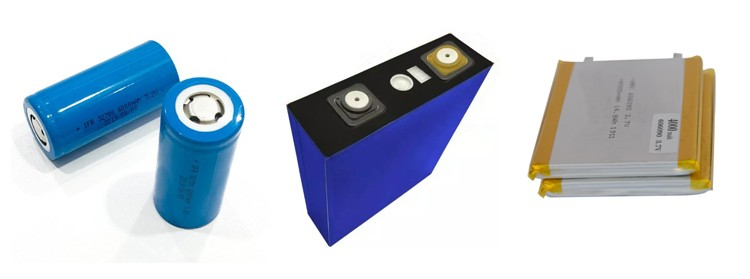
Meta description: Compare prismatic, cylindrical and pouch LiFePO₄ cell formats — differences in mechanical design, thermal behavior, assembly, and best-fit applications for solar and storage projects.
Keywords: prismatic LiFePO4, cylindrical LiFePO4, pouch cell ESS, cell form factor comparison
Intro
Cell form factor influences pack assembly cost, thermal management, energy density and serviceability. This guide compares the three mainstream LiFePO₄ cell formats, explains typical uses, and offers selection advice for system integrators.
Form Factor Comparison Table
| Feature | Prismatic | Cylindrical | Pouch |
|---|---|---|---|
| Packaging | Hard metal case | Steel can | Laminated pouch |
| Energy density (pack) | High (good volumetric) | Moderate | Highest (by weight) |
| Thermal dissipation | Moderate | Excellent radial dissipation | Poor — needs thermal plates |
| Mechanical robustness | High | Very high | Low — needs external protection |
| Assembly complexity | Easier module stacking | Requires holders | Requires module frames & compression |
| Cost | Mid-high | Cost-effective at scale | Lower cell cost but higher assembly cost |
Application Guidance
- Residential ESS / Rack systems: Prismatic favored due to easy stacking and robust casing.
- High-power modules / EV-like applications: Cylindrical provides good thermal paths and mechanical stability.
- Weight-sensitive or compact designs: Pouch cells deliver compact pack mass but need thorough mechanical design.
Thermal & Safety Considerations by Type
- Pouch cells require pressure plates and cell compression to prevent swelling and ensure consistent contact.
- Cylindrical cells can benefit from forced-air channels in racks.
- Prismatic modules often integrate thermal interface materials (TIM) and heatsinks.
Conclusion
Choose cell type based on mechanical constraints, thermal design, cost targets, and manufacturing capability. For most stationary ESS where durability and serviceability matter, prismatic LiFePO₄ is common; cylindrical is chosen for robust thermal performance; pouch fits niche lightweight designs.
Tags: cell form factors, prismatic LiFePO4, pouch cell design
CTA: Need help selecting cell form factor? Send us your system spec and we’ll recommend an optimal cell type.