
Primary keywords: LiFePO4 battery, lithium iron phosphate battery, LiFePO4 chemistry
Secondary keywords: cathode material, battery working principle, lithium battery structure
Introduction
Lithium iron phosphate (LiFePO₄ or LFP) batteries have become one of the most important battery chemistries in modern energy storage systems. Compared with traditional lithium-ion batteries such as NMC or LCO, LiFePO₄ batteries offer superior safety, longer cycle life, and better thermal stability. These advantages make them a preferred choice for solar energy storage, telecom backup power, RV systems, marine applications, and industrial ESS.
This article explains what a LiFePO₄ battery is, how it is structured, and how it works internally.
1. Chemical Composition of LiFePO₄ Batteries
The core of a LiFePO₄ battery is its cathode material—lithium iron phosphate (LiFePO₄).
Main components include:
- Cathode: LiFePO₄
- Anode: Graphite (carbon)
- Electrolyte: Lithium salt (typically LiPF₆) in organic solvent
- Separator: Microporous polymer film
The olivine crystal structure of LiFePO₄ provides strong covalent bonds between iron, phosphate, and oxygen atoms, which significantly improves chemical and thermal stability.
2. Internal Structure of a LiFePO₄ Cell
A typical LiFePO₄ cell consists of layered electrodes wound or stacked together:
- Aluminum foil current collector coated with LiFePO₄ (cathode)
- Copper foil current collector coated with graphite (anode)
- Separator placed between electrodes to prevent short circuits
- Electrolyte filling microscopic pores to enable lithium-ion transport
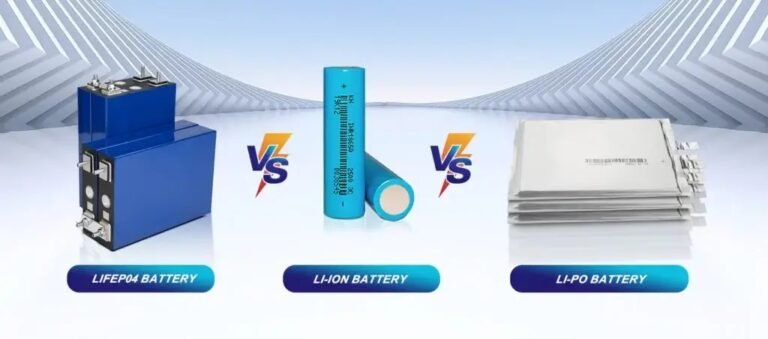
Cells can be manufactured in cylindrical, prismatic, or pouch formats.
3. Working Principle
During charging:
- Lithium ions move from the cathode to the anode
- Electrons flow through the external circuit
During discharging:
- Lithium ions migrate back to the cathode
- Electrical energy is released to the load
This reversible intercalation process enables thousands of charge–discharge cycles with minimal degradation.
4. Nominal Voltage and Electrical Characteristics
- Nominal voltage per cell: 3.2–3.3 V
- Fully charged voltage: ~3.65 V
- Cut-off voltage: ~2.5 V
These stable voltage characteristics make LiFePO₄ ideal for battery pack design.
Conclusion
LiFePO₄ batteries combine chemical stability, mechanical robustness, and reliable electrochemical performance. Their unique crystal structure is the foundation for long cycle life, high safety, and wide application in modern energy storage.