
Battery Runtime Explained: How Long Will Your Battery Last?
After understanding battery capacity, the next question naturally becomes:
How long will my battery power my equipment?
This is one of the most frequently asked questions in the energy storage industry.
Whether you are purchasing a battery for a home, an off-grid cabin, a telecom station, or a commercial facility, estimating runtime is essential for selecting the correct battery size.
However, battery runtime is often misunderstood because it depends on several variables rather than battery capacity alone.
The Basic Runtime Formula
Battery runtime is determined by the relationship between available energy and electrical load.
The simplified engineering formula is:
Where:
- Runtime = operating time (hours)
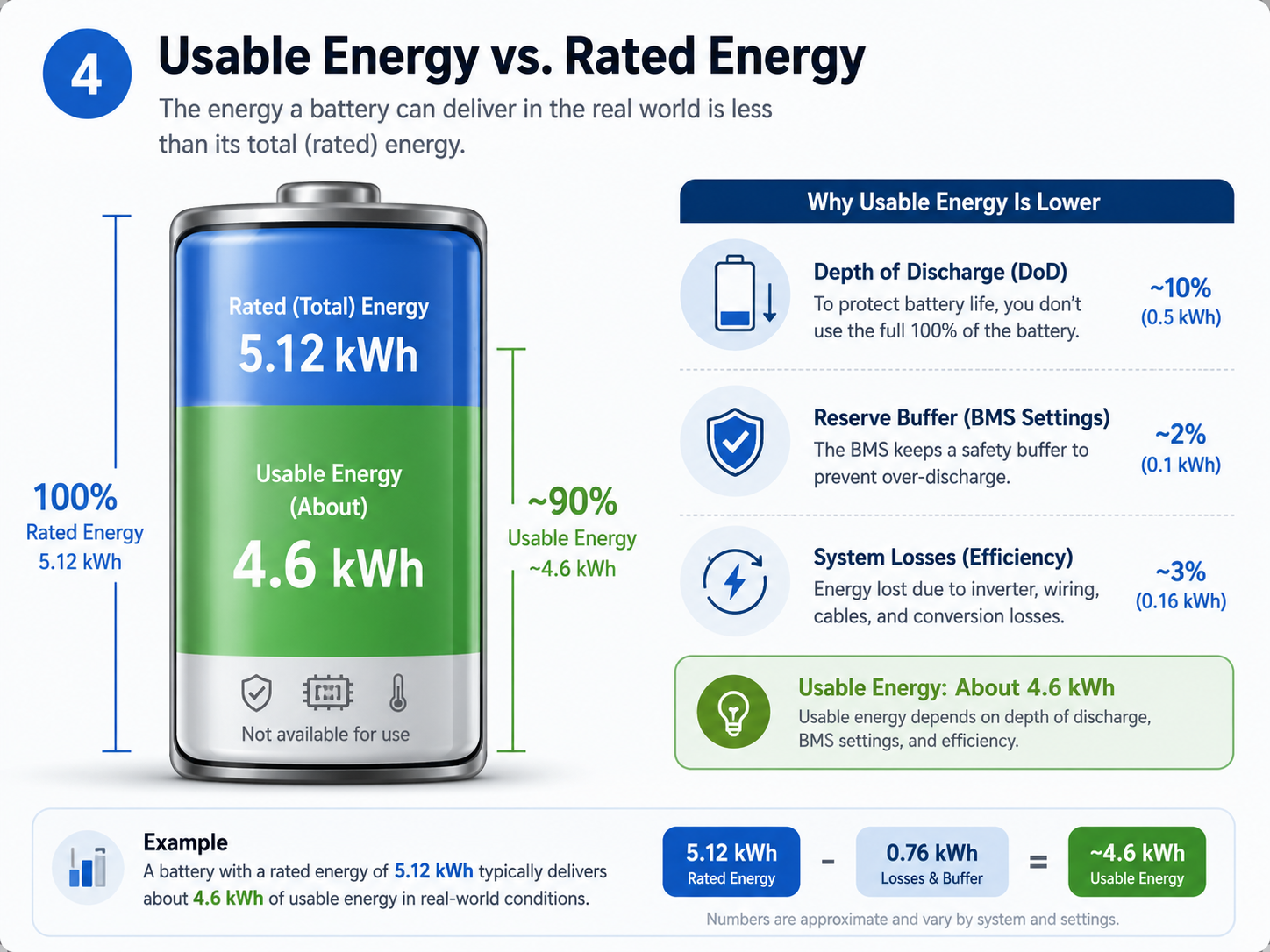
- Usable Energy = battery energy available after considering DOD and efficiency (kWh)
- Load = average electrical power consumption (kW)
This equation forms the basis of almost every battery sizing calculation.
Example 1 – 10kWh Battery + 1kW Load
Assume a battery provides:
10 kWh usable energy
The connected load is:
1 kW
Runtime:
Under ideal conditions, the battery can power the load for approximately 10 hours.
Example 2 – 10kWh Battery + 2kW Load
Battery:
10 kWh
Load:
2 kW
Runtime:
Doubling the load approximately halves the runtime.
Example 3 – 10kWh Battery + 500W Load
Battery:
10 kWh
Load:
500 W
First convert watts to kilowatts:
Runtime:
This illustrates why lower-power appliances can operate for much longer periods.
Example 4 – Residential Evening Backup
Typical evening loads:
| Appliance | Power |
|---|---|
| LED Lighting | 120W |
| Refrigerator | 180W |
| Television | 120W |
| Wi-Fi Router | 20W |
| Laptop | 80W |
Total:
520W
Converted to kilowatts:
0.52 kW
Battery:
10.24 kWh
Assuming approximately 9.5 kWh usable energy:
Runtime:
In practice, the runtime may vary because refrigerators and similar appliances cycle on and off rather than operating continuously.
Example 5 – Air Conditioner
Air conditioners are among the largest residential electrical loads.
Assume:
Average operating power:
1500W
Battery:
10.24 kWh
Usable energy:
9.5 kWh
Runtime:
Because inverter-driven air conditioners adjust compressor speed, actual runtime depends on ambient temperature and cooling demand.
Example 6 – Office Backup
Small office equipment:
| Equipment | Power |
| Computers | 500W |
| Network Equipment | 150W |
| LED Lighting | 250W |
| Security System | 100W |
Total:
1000W
Runtime:
Battery:
20 kWh usable
Load:
1 kW
Runtime:
Example 7 – Telecom Station
Typical telecom equipment:
- DC power system
- Base station equipment
- Network switches
- Environmental monitoring
Average load:
2500W
Battery:
48V
200Ah
Energy:
10.24 kWh
Usable:
9.5 kWh
Runtime:
This simplified calculation helps telecom engineers estimate backup duration before generator startup.
Example 8 – Off-Grid Cabin
Daily consumption:
- Lighting
- Water Pump
- Refrigerator
- Television
- Laptop
Average daily energy:
6 kWh
Battery:
16.08 kWh
Usable:
Approximately 15 kWh
Days of autonomy:
This approach is often used when designing off-grid solar systems.
Runtime Depends on More Than Capacity
Many people assume runtime depends only on battery size.
In reality, several additional factors influence actual operating time.
These include:
- Load fluctuations
- Inverter efficiency
- Ambient temperature
- Battery age
- Cable losses
- Starting currents of inductive loads
Therefore, runtime calculations should always be considered estimates rather than guarantees.
Continuous Load vs Peak Load
Another important concept is the difference between:
Continuous Load
The average power consumed over time.
Examples:
- Lighting
- Refrigeration
- Networking equipment
Peak Load
Short-duration power spikes.
Examples:
- Air conditioner startup
- Water pump startup
- Air compressor
- Electric motor
The inverter and battery must be capable of supporting both continuous and peak power demands.
Runtime Comparison Table
The following table provides approximate runtimes for a 10kWh usable battery under continuous load.
| Continuous Load | Approximate Runtime |
| 100W | 100 Hours |
| 250W | 40 Hours |
| 500W | 20 Hours |
| 750W | 13.3 Hours |
| 1kW | 10 Hours |
| 2kW | 5 Hours |
| 3kW | 3.3 Hours |
| 5kW | 2 Hours |
These values assume stable operating conditions and do not account for transient peak loads.
Engineering Insight
A common mistake is sizing a battery based only on maximum inverter power.
For example, a homeowner may install a 5kW hybrid inverter and assume the battery must continuously supply 5kW.
In reality, the average household load is often much lower.
Professional system design therefore begins with an energy consumption profile, not simply the inverter’s rated output.
Analyzing hourly load patterns results in more accurate battery sizing, improved economics, and longer battery life.
Chapter Summary (Part 3)
Battery runtime is determined by both usable battery energy and electrical load.
Accurate runtime estimation requires consideration of:
- Usable capacity
- Continuous load
- Peak load
- Inverter efficiency
- Battery aging
- Environmental conditions
Understanding these relationships enables homeowners, installers, and engineers to design energy storage systems that provide reliable backup while avoiding unnecessary oversizing.
In the next section, we will examine battery sizing methodology, explaining how professionals determine the optimal battery capacity for residential, commercial, telecom, and off-grid applications using real-world design examples.