
Rated Capacity vs. Usable Capacity
One of the most common misunderstandings in energy storage is assuming that a battery labeled 10 kWh will always deliver 10 kWh of usable electricity.
In reality, the energy available to the user is almost always lower than the battery’s rated capacity.
Understanding the difference between rated capacity and usable capacity is essential for selecting the correct battery size, estimating backup time, and comparing products from different manufacturers.
What Is Rated Capacity?
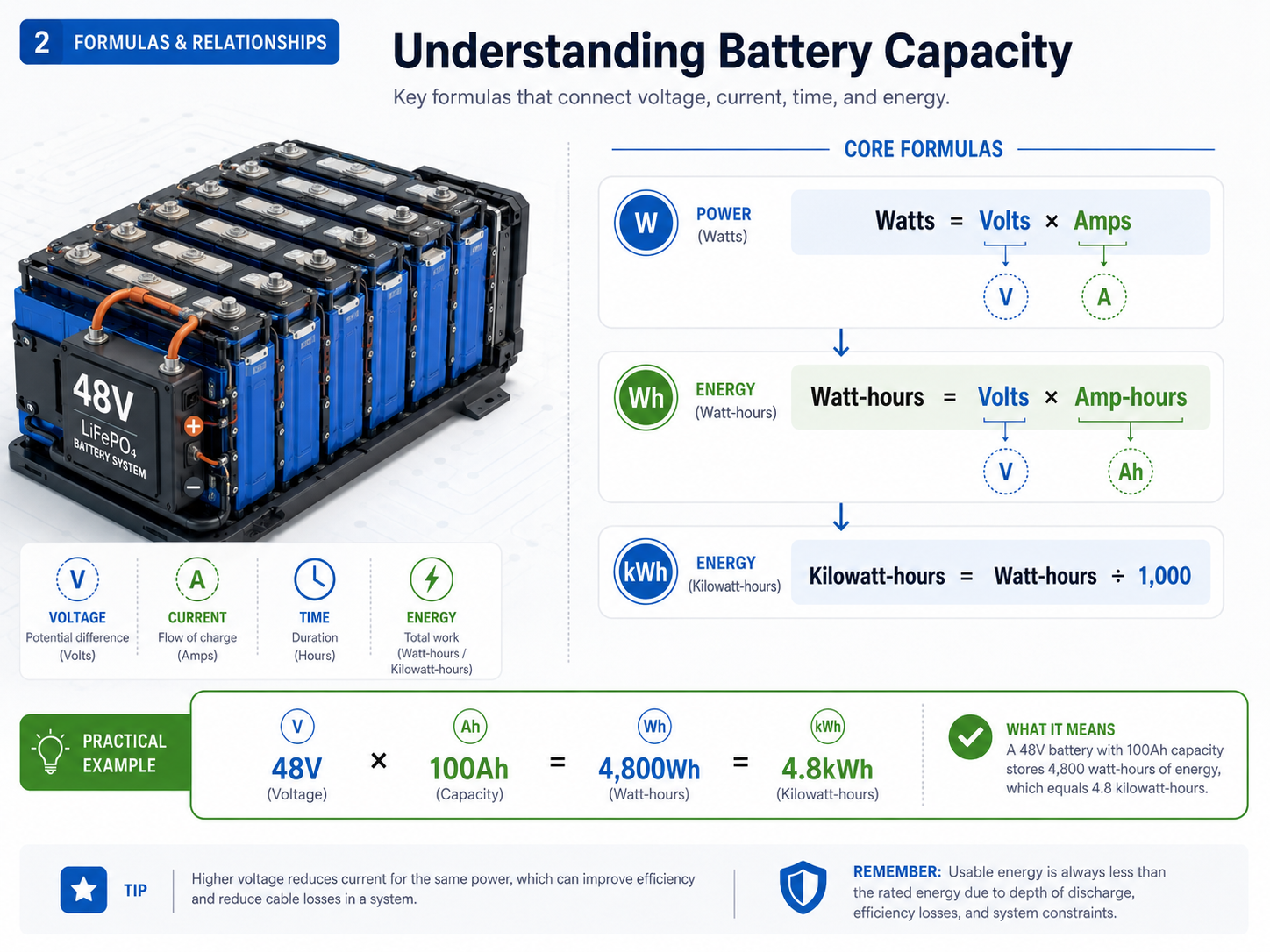
Rated capacity is the total amount of electrical energy stored inside the battery under specified laboratory test conditions.
For example, a battery may be specified as:
- Nominal Voltage: 51.2V
- Capacity: 200Ah
Its rated energy is therefore:
This figure represents the battery’s theoretical stored energy.
However, in real-world operation, users rarely have access to every watt-hour of that stored energy.
What Is Usable Capacity?
Usable capacity is the amount of energy that can realistically be delivered while maintaining safe operation and long battery life.
Several factors reduce usable energy:
- Depth of Discharge (DOD)
- Battery Management System protection
- Inverter efficiency
- Cable losses
- Ambient temperature
- Battery aging
As a result, usable energy is always equal to or lower than the rated capacity.
Understanding Depth of Discharge (DOD)
Depth of Discharge (DOD) describes how much of a battery’s stored energy is intentionally used before recharging.
For example:
A 10 kWh battery discharged by 9 kWh has experienced:
The remaining 10% serves as a protective reserve defined by the battery’s control strategy.
Why Batteries Are Not Fully Discharged
Many users ask:
“Why can’t manufacturers simply allow the battery to use 100% of its energy?”
The answer lies in battery longevity.
Completely exhausting a battery on every cycle increases stress on the cells and accelerates degradation.
To balance capacity and lifespan, most LiFePO4 energy storage systems reserve a small portion of the battery’s capacity.
This strategy:
- Protects the cells
- Improves cycle life
- Enhances long-term reliability
Typical DOD Values
The following table illustrates common recommendations for different battery technologies.
| Battery Chemistry | Typical Recommended DOD |
|---|---|
| Flooded Lead-Acid | 50% |
| AGM | 50–60% |
| GEL | 60–70% |
| OPzS | 70–80% |
| OPzV | 80% |
| LiFePO4 | 90–95% |
This is one reason why LiFePO4 systems provide significantly more usable energy than lead-acid batteries with the same nominal capacity.
Example: Comparing Usable Energy
Consider two batteries, both advertised as 10 kWh.
Battery A
Lead-acid
Recommended DOD:
50%
Usable energy:
Battery B
LiFePO4
Recommended DOD:
95%
Usable energy:
Although both batteries have the same rated capacity, the lithium battery delivers almost twice the usable energy in daily operation.
Round-Trip Efficiency
Another important factor influencing usable energy is round-trip efficiency.
This represents the percentage of stored energy that can be recovered after charging and discharging.
Some energy is always lost due to:
- Internal resistance
- Electronic components
- Heat generation
Typical values are shown below.
| Battery Type | Round-Trip Efficiency |
| Flooded Lead-Acid | 70–80% |
| AGM | 75–85% |
| GEL | 80–85% |
| OPzV | 85–90% |
| LiFePO4 | 95–98% |
Higher efficiency means more of the electricity generated by solar panels is actually available for use.
Calculating Real Usable Energy
Professional system designers often estimate usable battery energy using the following approach:
For example:
A battery rated at:
10.24 kWh
with:
- 95% DOD
- 96% round-trip efficiency
provides approximately:
This value more accurately reflects the energy available under normal operating conditions.
Why Temperature Changes Available Capacity
Battery capacity is also influenced by ambient temperature.
High Temperatures
Moderately elevated temperatures may temporarily increase available capacity but accelerate long-term aging.
Low Temperatures
Cold environments increase internal resistance, reducing the amount of energy that can be delivered until the battery warms.
For this reason, battery performance should always be evaluated within the manufacturer’s recommended operating temperature range.
Capacity Fade Over Time
Battery capacity does not remain constant throughout its service life.
Instead, it gradually decreases due to normal aging.
A simplified illustration:
| Battery Age | Approximate Remaining Capacity |
| New | 100% |
| After Several Years | 95–90% |
| Mid-Life | 90–85% |
| End of Rated Cycle Life | ~80% |
This gradual decline should be considered during system sizing, particularly for projects with long design lifetimes.
Engineering Example
Imagine a homeowner whose daily electricity consumption after sunset is approximately:
8 kWh
If the homeowner purchases a battery advertised as:
10 kWh
the assumption may be that the battery provides ample reserve.
However, after accounting for:
- DOD
- Efficiency
- Future capacity fade
the actual available energy may be closer to:
9.3 kWh
This still meets the requirement, but with a smaller reserve than expected.
Professional designers therefore include an additional safety margin rather than sizing systems exactly to today’s consumption.
Common Mistakes When Comparing Batteries
When evaluating quotations, buyers should avoid comparing products based only on:
- Amp-Hours
- Rated kWh
- Initial purchase price
Instead, consider:
- Usable energy
- DOD
- Round-trip efficiency
- Cycle life
- Warranty
- Operating temperature
- BMS capabilities
These factors determine the battery’s real-world value over its lifetime.
Engineering Insight
Some manufacturers advertise only the highest possible capacity under ideal laboratory conditions.
Professional buyers should always ask:
- What is the recommended DOD?
- What charging voltage is assumed?
- What efficiency value is expected?
- Under what temperature was the capacity measured?
Understanding these conditions enables fair comparisons between competing products.
Chapter Summary (Part 2)
Rated battery capacity is only the starting point.
The energy available to the user depends on several additional factors, including:
- Depth of Discharge
- Round-Trip Efficiency
- Temperature
- Battery Aging
- System Design
Professional battery sizing therefore focuses on usable energy, not simply the number printed on the product label.
In the next section, we will explore how battery capacity relates to runtime by calculating how long batteries of different sizes can power common household and commercial loads.