
Introduction
A common solar battery question sounds simple:
“What happens to the solar panels after the LiFePO4 battery becomes full?”
Some customers imagine that the panels will continue forcing electricity into the battery.
Others believe solar energy has nowhere to go and may damage the system.
In a correctly designed solar energy storage system, neither should happen.
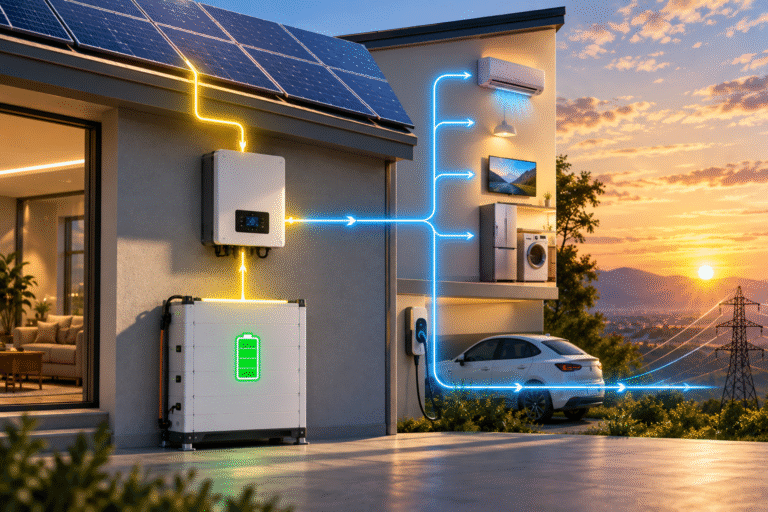
Once the battery reaches its charging target, the inverter or charge controller adjusts the system so that battery charging current is reduced or stopped.
Any remaining solar energy is then managed according to the system configuration.
It may be:
- Used by active loads
- Exported to the utility grid
- Redirected to another controllable load
- Curtailed
Understanding this process helps installers correctly design battery capacity and solar array size.
Solar Panels Do Not Force Maximum Power All the Time
A PV module does not continuously inject its maximum rated power into the system regardless of demand.
The MPPT controller or inverter controls the operating point of the solar array.
When more power is required, the controller attempts to operate near the array’s maximum power point.
When less power can be used, the controller can reduce the amount of power extracted.
Therefore, if:
- Battery is full
- Household loads are low
- Grid export is disabled
the inverter can simply reduce PV generation.
The panels remain exposed to sunlight, but the system does not have to draw their maximum available power.
Scenario 1: Battery Full + House Still Consuming Power
Suppose:
Solar production available: 6kW
Household load: 2kW
Battery: 100% SOC
If the battery no longer needs charging, the solar array can still provide the 2kW required by the house.
The remaining available solar power depends on system settings.
It may:
- Export to grid
- Be curtailed
The battery does not need to cycle unnecessarily just because solar energy is available.
Scenario 2: Battery Full + Grid Export Allowed
Now suppose the same system has permission to export electricity.
Solar available: 6kW
Loads: 2kW
Battery: full
Excess solar:
6kW − 2kW = 4kW
The inverter may export approximately the available excess power to the utility grid, subject to:
- Inverter limits
- Utility rules
- Export-control settings
This is common in grid-tied solar-plus-storage systems.
Scenario 3: Battery Full + Zero Export
Many commercial and residential systems operate with:
zero export
because local regulations or utility agreements do not allow electricity to be sent back to the grid.
In this case:
Solar available: 6kW
Loads: 2kW
Battery: full
The inverter cannot export the extra 4kW.
So it reduces solar generation to approximately what the site can actually use.
This process is called:
PV curtailment
The unused potential solar energy is simply not harvested.
Is PV Curtailment Dangerous?
No.
Curtailment is a normal control function in solar power systems.
When energy demand falls, the inverter changes the PV operating point and extracts less power.
This does not mean several kilowatts of electricity are being generated and then trapped somewhere.
The electrical operating conditions of the solar array simply change.
Why Oversized Solar Arrays Experience More Curtailment
Suppose a residential system has:
- 20kW PV
- 10kWh battery
- 3kW daytime load
- No grid export
On a sunny day, the battery may become full before noon.
After that, the house only consumes around 3kW.
A large portion of the available PV power may therefore be curtailed for several hours.
The system still works.
But the customer may not be using the solar investment efficiently.
This is why battery, PV and load should be sized together.
A Larger Battery Can Absorb More Midday Solar
Consider the same solar array with a larger battery.
Instead of 10kWh storage, the customer installs:
30kWh
The battery can absorb much more midday solar energy.
That stored energy can later supply:
- Evening loads
- Nighttime loads
- Peak tariff periods
Increasing battery capacity can therefore reduce PV curtailment.
However, larger batteries also increase project cost.
The correct capacity should be based on actual energy demand.
But a Bigger Battery Is Not Always the Answer
Suppose a customer has:
- Very low nighttime consumption
- High daytime solar
- No export allowed
Installing a very large battery may simply move the problem.
The battery becomes full later in the afternoon instead of before noon.
If the stored energy is not used overnight, the battery begins the next morning at a high SOC.
There is little space for new solar energy.
Therefore, battery capacity should reflect:
daily energy consumption, not just PV size.
Why Morning SOC Matters
Consider two identical solar systems.
System A
Battery begins the morning at 20% SOC.
System B
Battery begins at 80% SOC.
System A has much more empty capacity available for solar charging.
System B may become full quickly.
Therefore, energy-management strategy affects how much solar energy can be captured the next day.
This Is Important for Time-of-Use Systems
In regions with time-of-use electricity tariffs, the battery may charge from the grid at night when electricity is cheap.
But if it reaches 100% before sunrise, there may be no available capacity for solar energy the next morning.
This may be economically inefficient.
A smarter strategy can leave enough battery capacity for expected solar production.
For example, instead of charging fully from the grid, the ESS may stop at a lower target SOC if strong solar production is expected.
The exact strategy depends on:
- Electricity tariff
- Weather forecast
- PV capacity
- Load profile
- Backup requirements
Backup Requirements Can Change the Strategy
A customer living in an area with frequent grid outages may prefer to keep the battery at high SOC.
Why?
Because a blackout could happen at any time.
In this case, maximizing backup readiness may be more important than maximizing solar self-consumption.
Another customer with a very reliable grid may intentionally maintain more empty battery capacity during the day to capture solar production.
There is no universal SOC strategy.
What Happens at the Battery Level?
As the battery approaches its upper charging limit:
- Cell voltage rises
- Charging current may decrease
- BMS may reduce the permitted charging current
- Inverter receives the updated charging limit
- Charging eventually stops
With closed-loop CAN or RS485 communication, the BMS can communicate charging limits directly to the inverter.
Without communication, the inverter uses configured voltage limits.
In either case, the charger should not continue forcing full current into a battery that can no longer accept it.
Cell Balancing May Continue Near Full Charge
Some BMS designs perform passive balancing near the upper SOC range.
When one cell has slightly higher voltage than the others, the BMS may dissipate a small amount of energy from that cell.
This allows lower-voltage cells to catch up.
Therefore, a battery that appears nearly full may still show a small charging current for some time.
That does not necessarily indicate a problem.
Why the Battery May Switch Between 99% and 100%
Near full charge, users may observe SOC changing between values such as:
- 98%
- 99%
- 100%
This can result from:
- Small loads
- BMS SOC estimation
- Cell balancing
- Charger restart thresholds
The inverter may stop charging at the upper threshold and restart after battery voltage falls slightly.
A small amount of cycling near full SOC is not automatically a battery defect.
What Happens in an Off-Grid System?
Off-grid systems are particularly interesting because there is no utility grid to absorb extra energy.
Suppose:
- Solar available: 8kW
- Loads: 1kW
- Battery: full
Only approximately 1kW is required.
The rest of the solar potential must be curtailed.
This is completely normal.
The PV array does not need a physical “dump load” in a typical modern solar ESS unless the system architecture specifically requires one.
Can Excess Solar Be Used More Productively?
Yes.
Instead of curtailing solar power, an energy-management system can activate flexible loads.
Examples include:
- Water heating
- Water pumping
- EV charging
- Air-conditioning
- Ice making
- Desalination
- Industrial processes
These are sometimes called:
deferrable loads
or
smart loads
The system can run them when surplus solar power is available.
This can improve overall solar utilization.
Example: Solar Water Heating Load
Suppose:
PV available: 10kW
House loads: 3kW
Battery: full
Normally, 7kW might be exported or curtailed.
If a controlled electric water heater uses 3kW, solar utilization increases.
New balance:
- House: 3kW
- Water heater: 3kW
- Remaining excess: 4kW
Smart load control can therefore reduce wasted solar potential.
EV Charging Is Another Opportunity
A home with:
- Solar
- LiFePO4 battery
- Electric vehicle
can coordinate charging intelligently.
Priority might be:
- Supply household load.
- Charge stationary battery.
- Charge EV with surplus solar.
- Export remaining power.
Alternatively, the owner may prioritize the EV before the stationary battery.
The correct sequence depends on user requirements.
Commercial Sites Can Use Load Shifting
Factories and commercial buildings often have more opportunities to use surplus solar.
Flexible equipment can be scheduled around midday.
For example:
- Pumps
- Compressors
- Refrigeration
- Water treatment
- EV fleets
Instead of storing all solar energy in batteries, some loads can be operated directly when solar production is high.
Direct use avoids an unnecessary:
charge → discharge
cycle through the battery.
Why Direct Solar Consumption Is Efficient
If solar electricity directly powers a load:
PV → inverter → load
the energy does not need to enter and leave the battery.
If energy is stored first:
PV → battery charging → battery storage → inverter → load
additional conversion stages occur.
Therefore, when practical, daytime loads should often be supplied directly from solar.
Battery storage is most valuable for shifting energy to times when solar is unavailable.
Should the Battery Always Have First Priority?
Not necessarily.
Different systems can use different priorities.
Backup Priority
Keep the battery near full.
Self-Consumption Priority
Use solar for loads first, then charge battery.
Peak-Shaving Priority
Reserve battery capacity for expensive tariff periods.
Off-Grid Priority
Maintain enough stored energy to survive the night and poor weather.
The battery charging target should follow the energy-management objective.
What if the Battery Repeatedly Becomes Full at 11 a.m.?
This can indicate several possibilities.
Battery Is Too Small
There is not enough storage capacity for available solar.
Nighttime Load Is Too Small
The battery does not discharge enough overnight.
PV Is Oversized
Solar generation is large relative to demand.
Grid Charging Is Too Aggressive
The system begins each morning at high SOC.
Load Scheduling Is Poor
Flexible loads could be moved to daytime.
None of these necessarily indicates a battery problem.
They indicate that the energy flow could be optimized.
How Distributors Can Diagnose the Situation
When a customer says:
“The battery is full too early and I am wasting solar power.”
Ask for:
- PV capacity
- Battery capacity
- Daily energy consumption
- Daytime consumption
- Nighttime consumption
- Morning SOC
- Grid export permission
- Grid charging schedule
- Inverter model
- Electricity tariff
This information can reveal whether the best solution is:
- More battery capacity
- Different SOC settings
- Load shifting
- EV charging
- Export
- Different inverter configuration
Example: 15kW PV with 16kWh Battery
Consider:
PV array: 15kW
Battery: approximately 16kWh
Nighttime energy use: 5kWh
The battery may begin the morning with only around 5kWh of free capacity.
On a strong solar day, that space can fill quickly.
Afterward, most additional solar energy must be:
- Used directly
- Exported
- Curtailed
Installing a larger battery may help—but only if there is enough evening or nighttime load to use the additional stored energy.
B2B Project Design Should Use a 24-Hour Energy Profile
Instead of asking only:
“How many kilowatts of solar?” and “How many kilowatt-hours of battery?” professional ESS design should examine the full daily energy profile.
A useful profile shows:
- 00:00–06:00 consumption
- Morning consumption
- Midday solar production
- Afternoon consumption
- Evening peak
- Overnight base load
This makes it much easier to determine:
- Battery capacity
- Charging window
- Solar utilization
- Expected curtailment
Seasonal Changes Matter
A system can behave very differently in:
- Summer
- Winter
- Rainy season
For example, summer may produce excess solar every day.
During winter, the same battery may struggle to reach full charge.
Therefore, occasional solar curtailment during high-production seasons is not automatically poor design.
The project should be optimized for annual performance rather than one perfect sunny day.
Conclusion
When a LiFePO4 battery becomes full, the solar system does not continue forcing unlimited energy into it.
The inverter or charge controller reduces battery charging and manages the remaining solar power.
Depending on system configuration, excess PV can be:
- Used by loads
- Exported to the grid
- Directed to flexible loads
- Curtailed
If a battery frequently becomes full very early in the day, the solution is not automatically to buy a bigger battery.
The complete energy profile should first be evaluated.
A well-designed ESS balances:
- PV capacity
- Battery capacity
- Daytime load
- Nighttime load
- Backup requirements
- Grid export
- Charging strategy
HIZN supplies LiFePO4 energy storage batteries for residential, commercial and off-grid solar systems with flexible capacities and CAN/RS485 communication options.
If you are designing a solar storage project, send us your PV size, daily consumption, daytime/nighttime load and inverter model. We can help evaluate whether the proposed battery capacity can make effective use of the available solar energy.