
Introduction
A LiFePO4 battery system works normally in a factory test at low altitude. The same inverter, charger and battery are later installed at a mining site 2,500 meters above sea level, where charging power begins to fall during the warmest part of the day.
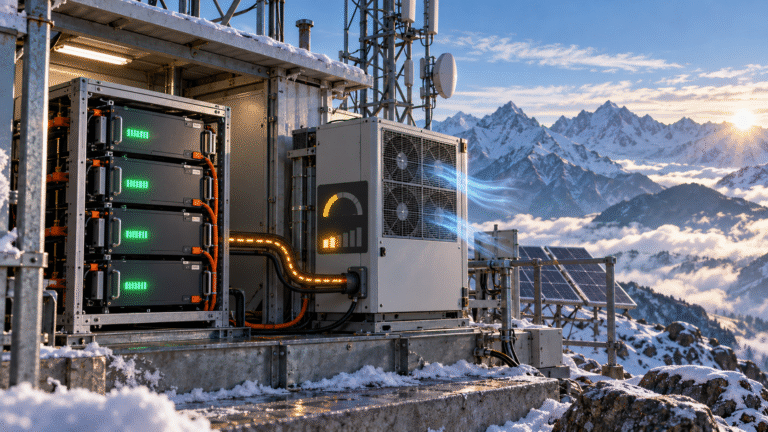
The battery temperature looks acceptable and the BMS reports no current limitation. The customer naturally suspects the battery, but high-altitude installations introduce another factor that is easy to overlook: power electronics rely heavily on air for cooling, and air density decreases as altitude increases.
The LiFePO4 chemistry itself does not suddenly become incompatible simply because a site is on a mountain. In many projects, the more important altitude-related limitation comes from the inverter, charger, PCS, generator or other air-cooled electrical equipment.
For telecom, mining, mountain resorts, remote solar projects and high-altitude commercial ESS, altitude should therefore be considered during system design rather than discovered after commissioning.
Why Altitude Changes Cooling
Most inverter chargers dissipate heat through a combination of heat sinks and forced or natural airflow. Air passing over those components carries heat away.
At higher altitude, air becomes less dense. The same fan can move a similar volume of air, but that volume contains less mass. Its ability to remove heat can therefore be reduced.
If the charger continues operating at full power, internal semiconductor and magnetic-component temperatures may rise more quickly.
Manufacturers can respond by specifying an altitude above which power derating is required.
Altitude Derating Is Equipment-Specific
There is no universal rule that every charger must reduce power by the same percentage at 2,000 or 3,000 meters. Different products use different cooling systems, component margins and insulation designs.
One inverter may be rated for full output up to a certain altitude and then require gradual derating. Another may have a different threshold.
The correct information should come from the inverter, charger or PCS datasheet.
For an ESS supplier, the most important lesson is simple: do not assume sea-level nameplate power is available at every project altitude.
The Battery and Charger Can Have Different Altitude Ratings
A LiFePO4 battery cabinet may have one environmental specification while the inverter has another. The system rating is effectively limited by the weakest applicable component.
For example, the battery may operate normally at 3,000 meters, while the charger requires power reduction above 2,000 meters. The customer sees reduced charging power and concludes that the battery cannot accept current at altitude.
In reality, the charger is protecting its own electronics.
This distinction can prevent unnecessary battery replacement.
High Ambient Temperature Makes the Problem Worse
Altitude and temperature should be considered together.
A 2,500-meter mountain site can still experience strong solar radiation and high daytime cabinet temperature. If the charger already has reduced cooling capability because of thinner air, elevated ambient temperature leaves even less thermal margin.
Charging may therefore operate normally early in the morning and derate in the afternoon.
This time-of-day pattern is a useful clue. If BMS temperature and CCL remain normal while the inverter temperature rises and charging power falls, the limitation is likely on the power-electronics side.
Direct Sunlight Can Raise Cabinet Temperature Far Above Ambient
An outdoor ESS cabinet should not be evaluated from weather-station air temperature alone. Metal enclosures exposed to strong solar radiation can become substantially hotter inside.
At high altitude, solar intensity can also be severe. Combining direct sunlight, insufficient ventilation and lower air density can create a difficult environment for inverter cooling.
Where possible, equipment layout should reduce direct solar exposure and maintain the airflow required by the manufacturer.
A shade structure can help, but it should not block ventilation paths.
Fans Cannot Make the Air Cooler Than Ambient
Forced-air cooling improves heat transfer, but a fan does not create refrigeration. If the surrounding air is already hot, the equipment still operates in a hot environment.
At altitude, the lower density of that hot air further reduces its cooling effectiveness.
For high-power commercial systems, active cooling or an air-conditioned electrical room may be required depending on the equipment specification.
Do not assume that adding a larger fan is always an adequate substitute for proper thermal design.
Charging Creates Continuous Thermal Load
Battery charging can keep an inverter or rectifier near high output for several hours. This is a different thermal condition from supplying a short peak load.
Suppose a charger delivers 20kW continuously while recovering a large battery after an outage. Even at high efficiency, a portion of the input power becomes heat inside the converter.
At altitude, removing this heat can become more difficult.
A charger that successfully produces 20kW for ten minutes may still thermally derate during a three-hour recharge.
Example: High-Altitude Telecom Site
Consider a remote telecom station installed at 3,000 meters. The site uses a 51.2V LiFePO4 battery bank and several rectifier modules.
After a long outage, the battery needs substantial recovery charging. The rectifier system is theoretically capable of 100A after supplying the telecom load, but in the afternoon the modules reduce output because their internal temperature rises.
The battery charges at only 60A even though its BMS permits 100A.
If the design calculation used only the sea-level 100A rectifier rating, the actual recovery time at site will be much longer than expected.
Telecom Redundancy Can Also Be Affected
A system may be designed as N+1 at normal conditions. If every rectifier module has to derate at altitude and high temperature, the actual spare capacity can shrink.
The site may technically still have an extra physical module but no longer have enough usable output to maintain both telecom load and planned battery recharge current after one module fails.
Therefore, altitude derating should be included in redundancy calculations.
This is especially important for unmanned sites where recovery performance directly affects network reliability.
High-Altitude Mining ESS Has Similar Challenges
Mining and remote industrial projects often combine high altitude with large loads, dust and significant daily temperature variation.
A battery system may support heavy equipment, communication systems or site facilities. If the PCS must charge rapidly during a short generator or grid window, any altitude-related power derating can affect the operational plan.
A 50kWh battery that must recover in two hours requires much more charging power than the same battery allowed six hours.
The higher the required charging power, the more important the real site derating becomes.
Generator Output Can Also Change with Altitude
Battery charging systems at remote mountain sites frequently use diesel or gas generators. Combustion engines depend on oxygen from the air, and generator performance can also be affected by altitude.
This creates a double constraint. The generator may provide less usable power while the charger simultaneously has reduced cooling margin.
A project that works perfectly at the factory can therefore experience lower charging power in the field even though every component is technically functioning.
Generator altitude ratings should be checked separately from charger ratings.
Do Not Increase Charger Current to Compensate for Derating
If the charger is reducing power because of internal temperature, increasing the configured current limit usually does not solve the problem.
The equipment will continue protecting itself, or it may reach a more severe thermal shutdown.
The correct solutions may involve improved cooling, lower continuous power, larger or additional charger capacity, or selecting equipment rated appropriately for the installation altitude.
Protection settings should not be overridden simply to recover sea-level output.
Altitude Can Also Affect Electrical Insulation Requirements
Cooling is not the only engineering consideration. At higher altitude, reduced air density can also affect electrical clearances and dielectric behavior in higher-voltage equipment.
This becomes more important in high-voltage commercial ESS and PCS installations than in ordinary 12.8V or 51.2V battery systems.
Professional equipment manufacturers therefore specify environmental and altitude limits as part of their certification or application guidance.
For high-voltage projects, altitude should be declared to both battery and PCS suppliers during the quotation stage.
High-Voltage ESS Deserves Extra Attention
A residential 51.2V battery installation and a 700V commercial battery rack are very different electrical environments.
At several hundred volts DC, insulation coordination, creepage distance, clearance and protective devices become much more important.
If a project will be installed at 3,000 or 4,000 meters, the engineering team should verify that the complete HV battery and PCS architecture is approved for that altitude.
Do not assume that an indoor sea-level design can simply be moved to any mountain site.
Solar MPPT Equipment Also Has an Altitude Rating
The battery may be charged through a hybrid inverter or separate solar MPPT. That equipment also contains power electronics and cooling systems.
A high-altitude solar project can therefore experience reduced PV-to-battery charging power because the MPPT or inverter is derating, not because the PV array lacks energy.
Compare available PV power with actual charger output and device temperature.
If PV remains strong while inverter output decreases as internal temperature increases, thermal derating is a likely explanation.
Cold Nights Do Not Eliminate the Problem
Mountain sites can have very cold nights and strong hot sunlight during the day. The battery may therefore face low-temperature charging restrictions in the morning and charger thermal derating later in the afternoon.
These are two different limitations.
In the morning, the BMS may reduce charging because the cells are cold. In the afternoon, the battery may be warm enough while the inverter itself becomes hot.
A good monitoring system should record both battery temperature and power-electronics temperature.
Ventilation Design Should Follow the Equipment Manual
Installers sometimes place inverter chargers inside sealed or nearly sealed cabinets to protect them from dust and weather. This can severely restrict airflow.
At altitude, the cooling penalty can become even larger.
The enclosure design should respect the manufacturer’s required clearances, airflow direction and environmental conditions.
If dust protection requires sealed architecture, select equipment and cooling systems designed for that enclosure rather than blocking the standard ventilation path.
Dust Can Compound Thermal Derating
Mining and mountain-road sites can be dusty. Dust accumulation on fans, filters and heat sinks reduces cooling performance.
A system may operate normally when new but begin derating more frequently after several months because airflow has deteriorated.
Preventive maintenance should therefore include inspection of cooling paths.
Charging performance trends can sometimes provide an early warning of thermal degradation.
Example: 20kWh Battery with a 5kW Charger
Suppose a 20kWh battery needs 12kWh restored after a discharge. At a true 5kW battery-side charge rate, idealized recovery is less than three hours.
At altitude and high temperature, the charger may derate to 3.5kW. Recovery time now increases significantly.
If the customer expects the battery to be ready again before the next evening outage, this difference can matter operationally.
The charger has not failed; the system was simply designed without sufficient site-condition margin.
Example: Commercial PCS Derating
A commercial PCS is rated for 50kW. At the project’s altitude and ambient temperature, its manufacturer permits only 40kW continuous operation.
The battery can accept the full 50kW, but the PCS cannot safely provide it under those conditions.
Using 50kW in project calculations would underestimate charging time and overestimate peak-shaving capability.
Use the site-adjusted continuous rating, not only the brochure headline.
Charging Cable Current Still Needs Normal Evaluation
Altitude does not remove ordinary DC design requirements. Cables, busbars, fuses and terminals still need to be sized for the actual current.
If the charger is oversized to compensate for altitude derating, the DC system must still support its maximum possible output under cooler conditions.
Do not size cables only for the derated afternoon current if the system can produce substantially more power on a cold morning.
Design for the approved maximum operating condition.
Monitoring Helps Separate Battery and Charger Limits
For high-altitude troubleshooting, record battery SOC, battery temperature, BMS CCL, charger output current, charger internal temperature, ambient temperature and time of day.
If BMS CCL remains constant while charger temperature rises and power falls, the charger is probably the limiting component.
If charger temperature remains normal but CCL falls, investigate the battery instead.
Time-correlated data prevents one component from being blamed for another component’s protection behavior.
Information to Include in the RFQ
For a high-altitude ESS project, include installation altitude, minimum and maximum ambient temperature, indoor or outdoor installation, battery capacity, required charging power, inverter/PCS model, generator information and required recharge time.
Altitude is not a small optional detail for a high-power project.
Providing it early allows suppliers to check derating and select equipment with appropriate margin.
High Altitude Can Change the Best System Architecture
If very high charging power is required at altitude, one large charger operating near its thermal limit may be less attractive than several modular chargers sharing the load.
A modular architecture can provide redundancy and reduce the thermal burden per unit, although the specific design must still follow manufacturer recommendations.
Alternatively, a larger PCS operated below its nameplate rating may provide better margin than a smaller unit continuously pushed to its altitude-adjusted maximum.
The most economical solution depends on project criticality and required recovery time.
Conclusion
High altitude does not automatically make LiFePO4 batteries difficult to charge. In many installations, the battery is not the component most affected.
The more important issue is often that chargers, inverters, rectifiers, PCS equipment and generators can lose usable continuous power as altitude and temperature reduce their thermal and operating margins.
A reliable mountain, mining or high-altitude telecom project should therefore be designed using actual site altitude and environmental conditions rather than sea-level nameplate ratings.
HIZN supplies LiFePO4 energy storage batteries for telecom, off-grid, commercial and remote-site applications.
For a high-altitude battery project, send us the installation altitude, ambient-temperature range, battery capacity, required charging power and inverter/charger model. We can help identify the battery-side requirements and the environmental parameters that should be confirmed with the power-conversion supplier before installation.