
Introduction
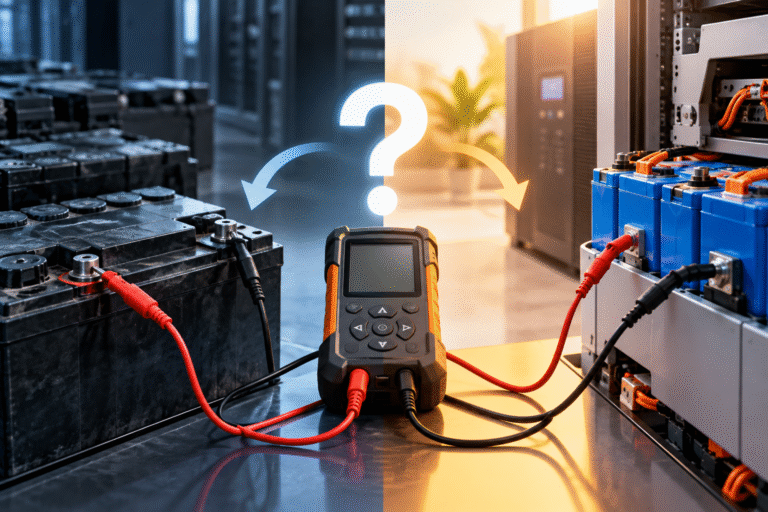
UPS service companies have used battery impedance, conductance and internal-resistance testers for many years. A technician can walk through a large VRLA battery room, measure each 12V block and identify batteries whose resistance is significantly higher than the others.
After a site is converted to LiFePO4, the same technician naturally asks: Can I keep using the same battery tester?
The answer is more complicated than a simple yes or no.
A traditional lead-acid battery tester may produce a numerical reading when connected to a LiFePO4 battery, but that does not automatically mean the value has the same diagnostic meaning. LiFePO4 chemistry has different impedance characteristics, and a finished lithium battery also contains a BMS, current sensors, MOSFETs, contactors, busbars and other components that can influence what the external tester measures.
For UPS distributors and battery maintenance companies, the most important principle is this: do not apply lead-acid pass/fail resistance limits directly to LiFePO4 unless the lithium battery manufacturer has specifically validated that method.
What Does “Internal Resistance” Actually Mean?
The phrase internal resistance sounds like one simple number, but batteries are electrochemical devices rather than fixed resistors.
Their electrical response depends on:
- SOC
- Temperature
- Test current
- Test frequency
- Measurement duration
- Cell chemistry
Different instruments can therefore produce different resistance or impedance values from the same battery. This is not necessarily because one instrument is defective. They may be measuring different aspects of battery behavior.
DC Resistance and AC Impedance Are Not Identical
One measurement method applies a DC current change and observes the resulting voltage change.
A simplified estimate is: R ≈ ΔV ÷ ΔI
Another method injects a small AC signal at a defined frequency and measures impedance. UPS battery conductance testers may use their own proprietary algorithms. These approaches should not be assumed to produce interchangeable numbers. If a battery datasheet specifies one test method, comparing it with a result from another method can be misleading.
Why Lead-Acid Battery Testers Became Popular
VRLA batteries are often installed in large strings containing dozens or hundreds of 12V blocks. Replacing or capacity-testing every block regularly would be time-consuming.
Impedance or conductance trending therefore became a useful maintenance tool. A block whose measurement changes significantly relative to its own baseline or neighboring batteries can be investigated further. This works best as trend analysis, not simply as one universal resistance number. The same principle becomes even more important with LiFePO4.
A Finished LiFePO4 Battery Is More Than Its Cells
When an external tester is connected to a 51.2V LiFePO4 battery terminal, the measured electrical path can include:
- Sixteen series cell groups
- Internal busbars
- Fuse or breaker
- Current shunt
- BMS power devices
- MOSFETs or contactor
- External terminals
The result is therefore not necessarily “cell internal resistance.” It is closer to the electrical behavior of the complete battery assembly under that measurement method. This can still be useful, but it should be interpreted correctly.
BMS MOSFETs Can Affect the Reading
Some lower-voltage LiFePO4 batteries use MOSFETs to control charge and discharge current. The MOSFET on-resistance becomes part of the battery’s terminal-to-terminal electrical path.
Temperature and BMS design can influence this resistance. Two batteries using different BMS hardware may therefore produce different external resistance readings even if they use similar cells. Comparing them against the same lead-acid resistance threshold makes little sense.
Contactors Can Also Add Resistance
Larger rack or cabinet batteries may use mechanical contactors. The contactor itself, internal busbars and connection points contribute small amounts of resistance. A degraded contactor can increase battery-terminal voltage drop even while the cells remain healthy.
In this case, an external resistance trend might actually help identify a system-level problem—but the cause would not necessarily be cell aging. Further diagnosis would still be required.
SOC Strongly Influences the Result
Battery impedance is not perfectly constant from 0% to 100% SOC. A measurement taken at 20% SOC should not automatically be compared with one taken at 90% SOC. For meaningful trend analysis, test conditions should be kept as consistent as practical.
For example, a maintenance company might standardize measurements around a defined SOC range after the battery has rested. Consistency is more valuable than collecting random resistance values at different operating states.
Temperature Is Equally Important
A battery tested at 10°C can show different electrical behavior from the same battery tested at 25°C. If one UPS room is air-conditioned and another is installed in a cold warehouse, comparing absolute resistance readings can be misleading.
Temperature should be recorded with the measurement. A sudden increase in resistance may reflect a colder battery rather than immediate degradation. Professional maintenance records should therefore include both resistance and temperature.
Charging or Discharging Current Can Distort the Test
Some resistance instruments assume the battery is at rest. If the UPS charger is actively supplying current or the battery is supporting load while the test is performed, the terminal voltage is already changing.
This can affect measurement quality. Follow the tester manufacturer’s instructions regarding whether the battery should be on float, at rest or disconnected from certain loads. Do not assume that the same test procedure used for a VRLA string is automatically appropriate for a smart lithium rack.
Can a 12V Lead-Acid Tester Be Connected to a 51.2V Battery?
Not unless the tester is explicitly rated for the battery voltage and test method. Some handheld automotive or small UPS testers are designed only for 12V lead-acid batteries. Connecting them to a 51.2V lithium battery can exceed the instrument’s input rating.
This is an equipment safety issue before it is even a measurement-accuracy issue. Always verify maximum supported voltage.
Automotive CCA Testers Are Particularly Unsuitable
Many consumer battery testers are designed to estimate cold-cranking amps for automotive lead-acid batteries. CCA is relevant to engine-starting batteries. A stationary LiFePO4 UPS battery may not have a meaningful CCA specification at all.
If an automotive tester displays: Good Battery or Replace Battery
when connected to an LFP battery, that result should not automatically be used as a warranty decision. The algorithm may be evaluating the battery against a completely inappropriate model.
Does Low Resistance Always Mean a Better Lithium Battery?
Not necessarily. Lower electrical resistance is generally helpful for high-power performance, but one resistance number does not define overall battery quality.
A battery can have low terminal resistance but still have:
- Reduced capacity
- Cell imbalance
- BMS communication faults
- SOC-calibration problems
- Temperature sensor faults
Conversely, a slightly higher resistance reading may come from the complete BMS/contact path rather than degraded cells. Battery health should be evaluated using multiple parameters.
Trend Analysis Is More Useful Than an Absolute Pass/Fail Number
Suppose a new LiFePO4 battery measures a particular impedance value under a controlled maintenance procedure. Six months later, under similar SOC and temperature, the value is almost unchanged. One year later, it remains close to baseline.
That trend is useful. Now imagine the same battery increases dramatically while neighboring batteries remain stable under similar conditions. That is a reason for further investigation. The important information is the change from its normal baseline.
Compare Similar Batteries Only
If a UPS bank contains four identical batteries from the same model and production generation, comparing them can be informative. Suppose three units show similar electrical behavior while the fourth is significantly different.
That outlier deserves attention. Do not compare a 51.2V 100Ah rack battery with a 51.2V 200Ah battery and conclude that one is defective because their resistance values differ. Different capacities and internal designs naturally produce different measurements.
Cell-Level Resistance Is a Different Measurement
A battery manufacturer may evaluate individual cell DC internal resistance before pack assembly. This measurement can be useful for cell matching. However, an external service technician measuring the complete battery at its terminals is not performing the same test.
The pack-level result includes many additional components. Therefore, factory cell IR specifications should not automatically be used as field pack-level acceptance limits. This distinction is important in warranty discussions.
BMS-Reported Resistance May Also Be Calculated Differently
Some BMS platforms display cell or pack resistance estimates. These values may be calculated from operational voltage/current changes rather than measured with the same method as a handheld tester.
Again, the numbers may not match. Instead of asking which value is “correct,” ask what each measurement method represents and whether the trend is changing abnormally. Engineering data without measurement context can easily be misinterpreted.
Capacity Testing Still Matters
Internal resistance is useful, but it does not directly measure how many Ah or kWh the battery can deliver. A battery with suspected degradation may still require a controlled capacity or energy test.
For UPS applications, the ultimate questions are whether the battery can deliver the required power and whether it can provide the required backup energy. Resistance monitoring helps identify emerging problems but should not completely replace functional performance testing.
High-Power Discharge Tests Reveal Another Type of Resistance
A practical UPS load test can show the complete voltage drop under realistic current. For example, measure battery voltage before load and during a stable high-power discharge.
If voltage falls much more than expected, investigate:
- Battery impedance
- Cable resistance
- Breakers
- Busbars
- Terminals
This type of system-level test can be more relevant to UPS performance than a tiny-signal handheld resistance reading.
Connector Resistance Can Be Misdiagnosed as Battery Resistance
Suppose the tester is connected outside a corroded or loose terminal connection. The measured result includes that connection resistance. The technician may conclude that the battery has aged.
After cleaning and correctly tightening the terminal, the reading returns closer to normal. This illustrates why resistance testing should be combined with visual inspection and thermal inspection. A resistance value tells you that something in the electrical path has changed, not necessarily exactly where.
Thermal Imaging Can Complement Resistance Testing
High resistance produces heat when current flows. During an UPS load test, a poor terminal, breaker or fuse connection may become warmer than surrounding components.
A thermal camera can therefore help locate resistance that a handheld tester alone cannot identify. For large lithium UPS systems, combining voltage-drop measurements, thermal inspection and BMS data often provides a clearer picture than relying on one resistance number.
Example: Four Parallel UPS Batteries
Consider four identical 51.2V batteries installed in parallel. During annual maintenance, three units show similar impedance readings while the fourth is significantly higher. Before declaring the fourth battery defective, the technician verifies SOC and temperature and repeats the test. The difference remains.
A controlled UPS load test then shows that the same battery carries less current than the others and its terminal voltage drops differently. Now there is stronger evidence that the battery or its branch connection needs further investigation. Multiple data points create a much stronger diagnosis than one tester reading.
Example: All Batteries Read Higher in Winter
An UPS service company measures every battery in December and finds resistance values significantly higher than those recorded in July. At first, the company suspects that the entire lithium installation has degraded.
Then it discovers that the battery room temperature is much lower during the winter maintenance visit. The batteries may be perfectly normal. Without recording temperature, the maintenance data could have triggered unnecessary warranty claims.
Should Dealers Publish a “Normal Internal Resistance” Number?
Be careful. A universal statement such as: “Every 51.2V 100Ah LiFePO4 battery must be below X milliohms” can be misleading because BMS design, cells, connection architecture and test method differ.
A manufacturer can provide an internal QC specification for a specific model and test method. Field maintenance should preferably use that model-specific information rather than generic internet values. When comparing data, measurement method must be consistent.
Can Impedance Monitoring Predict Failure?
It can help identify trends. A gradual increase in resistance can indicate aging, connection degradation or other changes. However, battery failure is not governed by resistance alone.
Lithium systems also provide BMS alarms, cell-voltage trends, temperature data and capacity information. A modern maintenance program should use these data sources together. This is one advantage of smart lithium batteries compared with traditional passive lead-acid blocks.
What Should UPS Service Companies Monitor Instead?
For LiFePO4 UPS installations, a useful maintenance program can include:
- Pack voltage
- Individual cell voltages
- Cell delta
- SOC
- SOH where meaningful
- Battery temperature
- Charge/discharge current
- BMS alarms
- Capacity/runtime test
- Connection temperature
- Pack-level resistance trend if validated
This provides a much more complete view of battery health. Resistance remains useful, but it becomes one part of the diagnostic picture.
Do Not Open the Battery to Measure Cells Unless Authorized
A service technician familiar with VRLA batteries may be tempted to open a lithium battery enclosure to access individual cell terminals. This should not be done unless the battery manufacturer specifically authorizes the procedure and the technician is qualified.
LiFePO4 ESS batteries contain high short-circuit energy and integrated electronics. Routine field maintenance should use approved external interfaces and BMS data wherever possible.
For UPS Distributors: Ask the Battery Supplier for a Maintenance Method
Before selling lithium batteries into professional UPS accounts, ask the manufacturer how battery health should be evaluated after one, three or five years. Questions should include whether external impedance testing is supported, which BMS parameters should be monitored and what capacity-test procedure is recommended.
This allows the distributor to offer a maintenance service that matches the product. It also prevents lead-acid maintenance habits from being transferred blindly to lithium.
For Battery Importers: Maintenance Documentation Can Be a Sales Advantage
Professional UPS customers often buy maintenance services along with batteries. A battery supplier who provides clear inspection procedures, BMS data interpretation and troubleshooting guidance is easier for UPS service companies to work with.
Importers can use this documentation to train dealers and service technicians. This creates a stronger B2B value proposition than competing only on battery price.
Conclusion
A traditional lead-acid battery impedance or internal-resistance tester may sometimes provide useful information on a LiFePO4 battery, but the reading should not automatically be interpreted using lead-acid pass/fail criteria.
LiFePO4 batteries have different electrochemical behavior and include BMS electronics, MOSFETs or contactors, busbars and other components that can influence terminal resistance.
For lithium UPS maintenance, resistance is most useful when used as a consistent trend measurement together with SOC, temperature, cell-voltage data, BMS alarms and capacity or load testing.
HIZN supplies LiFePO4 batteries for UPS, telecom and stationary backup applications with BMS monitoring and cell-level operating data.
If your company provides UPS battery maintenance and wants to use existing impedance-testing equipment with LiFePO4, send us the tester model, battery model and test procedure. We can help determine which battery-side data should be compared and whether a different maintenance approach is recommended.