
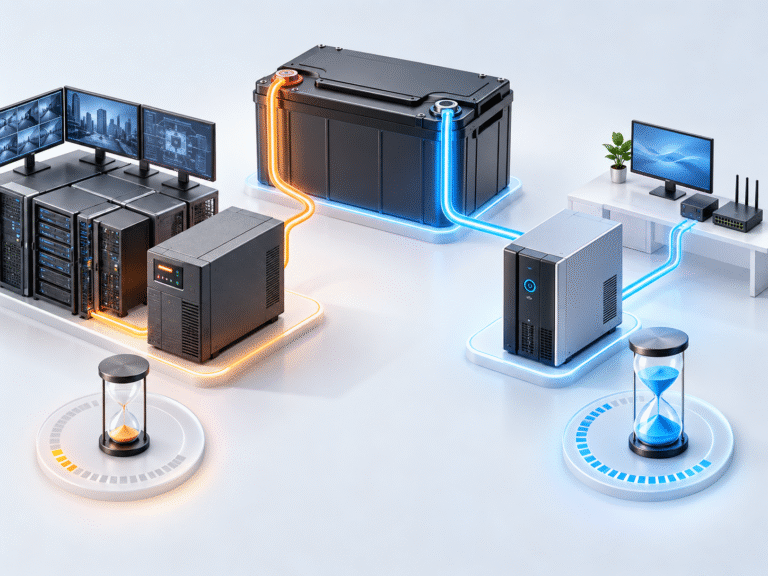
Begin with Actual Load, Not UPS Nameplate Rating
Suppose both UPS systems are rated at: 5kVA
This does not mean they are supplying the same load. UPS A may currently support 2kW while UPS B supports 2.5kW. That 500W difference can have a major impact on runtime.
If usable battery energy is 5kWh, an idealized calculation gives:
At 2kW: 5 ÷ 2 = 2.5 hours
At 2.5kW: 5 ÷ 2.5 = 2 hours
Before comparing UPS performance, measure actual real output power. Do not compare only load percentage or kVA rating.
Two UPS Units Can Have Different Efficiency
UPS conversion efficiency determines how much DC energy is required to supply a given AC load.
Suppose the connected equipment consumes: 3kW
UPS A operates at 95% efficiency:
Battery power is approximately: 3 ÷ 0.95 ≈ 3.16kW
UPS B operates at 88% efficiency: 3 ÷ 0.88 ≈ 3.41kW
The difference is approximately: 250W
Over a two-hour outage, that difference can consume roughly another 0.5kWh from the battery. This alone can create a noticeable runtime difference.
Efficiency Changes with Load Percentage
UPS efficiency is not always constant. A large UPS operating at only 10% of rated load may have lower efficiency than the same unit operating closer to its optimum range.
Therefore, replacing a small UPS with a much larger one does not automatically improve battery runtime. The larger UPS may consume more auxiliary power and operate less efficiently under the same small load. When comparing two systems, look at efficiency at the actual load level, not only peak efficiency printed on the brochure.
Online UPS and Line-Interactive UPS Behave Differently
UPS topology can affect energy consumption. A double-conversion online UPS continuously processes power through rectifier and inverter stages during normal operation and has specific battery-mode conversion characteristics. A line-interactive UPS uses a different architecture.
Their efficiency, transfer behavior and internal consumption can therefore differ. It is not meaningful to assume that two UPS systems with identical output ratings will extract the same amount of energy from the battery. Topology matters.
DC Cutoff Voltage Can Create a Large Runtime Difference
This is one of the biggest reasons the same LiFePO4 battery can produce different runtimes. UPS A may allow the battery voltage to fall deeper into its intended operating range before shutting down.
UPS B may use a more conservative low-battery cutoff designed around lead-acid batteries. The second UPS therefore stops earlier while useful battery energy remains. The battery has not lost capacity. The UPS simply uses a smaller portion of that capacity.
Example: Same Battery, Different Cutoff
Suppose the battery contains 5.12kWh nominal energy. UPS A uses an operating window that allows approximately 85% of that energy to be accessed. UPS B shuts down earlier and uses only approximately 70%.
Usable energy becomes:
UPS A: 5.12 × 0.85 ≈ 4.35kWh
UPS B: 5.12 × 0.70 ≈ 3.58kWh
The difference is approximately: 0.77kWh
At a 2kW load, that alone represents more than 20 minutes of potential runtime. Actual systems will vary, but the principle is important.
High DC Current Can Magnify the Difference
Suppose UPS B operates at a lower DC bus voltage or less efficiently, causing it to draw more current from the battery. Higher current produces more voltage drop in the battery and cables.
The UPS reaches its low-voltage threshold sooner. Therefore, UPS cutoff voltage and current are interconnected. A conservative cutoff becomes even more restrictive under high current.
Battery Connection Architecture Matters
UPS A may use short, large DC cables between the battery and inverter. UPS B may be installed several meters away with smaller cables. Even if the AC load is identical, the second system loses more voltage in the DC path.
The UPS sees a lower battery voltage and shuts down sooner. A customer comparing only the battery overlooks the installation difference. Runtime comparisons should include cable length and cross-sectional area.
UPS Internal Fans and Electronics Consume Energy
During battery operation, the UPS continues powering its own electronics.
Depending on design, this can include:
- Fans
- Control boards
- Display
- Relays
- DC/DC circuits
- Communication cards
The battery therefore supplies both the customer load and the UPS itself. A larger or older UPS may consume considerably more internal power than a smaller high-efficiency model. This reduces usable runtime.
UPS Output Power Factor Can Confuse the Comparison
One UPS may show: 50% load
while another also shows: 50% load
but their actual real power can differ. UPS nameplate ratings can include both kVA and kW. A 10kVA UPS with a 9kW real-power rating and another 10kVA UPS with a different kW rating should not be compared using load percentage alone. For battery-runtime calculations, record actual AC watts or kilowatts. This removes much of the ambiguity.
Low-Voltage Compensation Algorithms Can Differ
Some UPS systems use load-dependent battery thresholds. Under heavy load, the UPS may compensate for expected voltage sag and permit a different cutoff behavior. Another UPS may use a fixed voltage threshold.
These control strategies can produce different usable battery energy from the same LiFePO4 bank. This behavior is often hidden inside firmware and may not be obvious from the user manual. Field testing can therefore be extremely valuable.
Battery Detection and Self-Test Behavior Can Also Affect Runtime
Some UPS products periodically perform battery checks even during an outage or use specific algorithms to estimate remaining capacity. If the UPS incorrectly concludes that the battery is weak, it may begin a controlled shutdown earlier than expected.
Another UPS may continue operating normally from the same battery. This is why compatibility testing should include actual outage behavior, not only whether the UPS charges the battery successfully.
The Same UPS Can Also Give Different Runtime at Different Loads
Before blaming the UPS model, confirm that the two tests were performed under truly similar conditions. Servers can vary power consumption according to CPU load. Air conditioners cycle on and off.
Pumps and fans can change speed. Network equipment can add load. If one runtime test occurred during a quiet period and another during peak system activity, the battery results are not directly comparable. Use recorded UPS output kW throughout the test.
Starting SOC Must Be the Same
The battery needs to begin both tests from comparable conditions. If UPS A begins at a true BMS SOC of 100% and UPS B begins at 85%, a shorter runtime is expected. Do not rely only on the UPS front panel to confirm starting SOC.
After a lithium retrofit, UPS battery-percentage displays can be inaccurate. Use BMS SOC and charging history where possible.
Battery Temperature Must Also Be Comparable
If one test is performed in an air-conditioned room at 25°C and another in a cold warehouse, battery behavior can differ. Low temperature can increase impedance and reduce usable power.
The same battery may therefore reach the UPS low-voltage threshold sooner in the colder installation. Runtime comparisons should record temperature together with load and SOC. Without consistent test conditions, conclusions about UPS efficiency can be misleading.
Different Chargers Can Leave the Battery at Different Starting Conditions
UPS A may charge the battery to a higher but still approved voltage. UPS B may maintain a lower standby voltage. After several hours or days, the battery connected to UPS A may therefore begin an outage with more stored energy than when connected to UPS B.
Both systems may display “100% battery” even though actual battery energy is not identical. Charging compatibility affects discharge runtime indirectly. This is particularly relevant with legacy UPS equipment using lead-acid float settings.
One UPS May Trigger BMS Overcurrent While Another Does Not
Imagine the battery BMS allows 100A continuous discharge. UPS A operates efficiently enough that battery current remains around 85A. UPS B requires 105A under the same nominal AC load.
The first UPS continues running while the second eventually causes BMS protection. To the customer, the second UPS appears to have dramatically shorter runtime. The real limitation is current compatibility rather than battery capacity. This is why UPS distributors need both energy and power calculations.
DC Ripple and Dynamic Loads Can Also Differ
Different UPS topologies can draw different battery-current waveforms. The average DC current may appear similar while RMS or transient current differs. A battery BMS can respond differently to short current peaks.
For most installations, this will not be the first factor to investigate, but it can become relevant when a system operates close to BMS-current limits. If one UPS repeatedly triggers protection while another does not, battery-current waveform and transient behavior may deserve engineering review.
Example: Same 10kWh Battery on Two UPS Systems
Consider a 10.24kWh LiFePO4 battery.
UPS A:
- AC load: 4kW
- Efficiency: 94%
- Usable battery fraction before cutoff: 85%
Approximate usable AC energy: 10.24 × 0.85 × 0.94 ≈ 8.18kWh
Idealized runtime: 8.18 ÷ 4 ≈ 2.05 hours
UPS B:
- Same 4kW load
- Efficiency: 88%
- Usable battery fraction before cutoff: 72%
Approximate usable AC energy: 10.24 × 0.72 × 0.88 ≈ 6.49kWh
Estimated runtime: 6.49 ÷ 4 ≈ 1.62 hours
The difference is more than 25 minutes even though the battery itself is exactly the same. Real systems have additional variables, but this example shows why UPS architecture matters.
Two UPS Brands May Display Similar Battery Voltage but Stop Differently
One UPS may warn at 47V and continue operating for several minutes. Another may immediately begin shutdown at the same voltage. The front-panel number alone does not reveal the internal control strategy.
When dealers validate LiFePO4 compatibility, record the complete sequence:
- Battery Low warning
- Shutdown countdown
- Final DC cutoff
- BMS SOC at each stage
This provides a much better compatibility profile.
Same Battery Does Not Mean Same Runtime Display Either
Even if actual runtime is similar, two UPS systems can show very different estimated remaining time. One model may have an accurate lithium-compatible algorithm. Another may continue using a lead-acid runtime model.
Therefore, distinguish between: actual measured backup time and displayed estimated runtime. They are not the same performance metric.
How Battery Dealers Should Compare Two UPS Systems
Use the same battery at similar starting SOC and temperature, then connect the same stable AC load if practical.
Record:
- Starting BMS SOC
- AC output kW
- Battery voltage
- Battery current
- UPS DC input voltage
- BMS lowest cell voltage
- UPS low-battery warning time
- Final shutdown time
- Final BMS SOC
This allows the dealer to identify exactly where the runtime difference comes from. A casual test based only on the UPS front-panel percentage is not sufficient.
What If UPS B Stops with 30% BMS SOC Remaining?
First verify that the BMS SOC is accurate. Then check UPS DC cutoff and battery voltage under load. If the UPS consistently shuts down while all cell voltages remain healthy and significant actual energy remains, its operating window may simply be conservative for that lithium battery.
Possible solutions may include using more battery capacity or selecting a UPS with better lithium compatibility. Do not bypass the UPS protection system.
What If Both UPS Units Stop Near 0% SOC but Runtime Is Still Different?
Then focus more heavily on:
- Actual AC load
- UPS efficiency
- Internal power consumption
- Battery current
- Temperature
If both systems use approximately the same battery SOC window but one extracts energy faster, conversion efficiency or load is likely contributing. This illustrates why runtime analysis should be systematic rather than based on one assumption.
Compatibility Is More Than “Will It Turn On?”
A UPS and LiFePO4 battery may be considered electrically compatible because the UPS starts, charges the battery and supplies a load.
But professional B2B compatibility should also consider:
- Full-load discharge
- Low-SOC behavior
- Actual usable runtime
- BMS-current margin
- Charging recovery
- Self-test behavior
- Alarm behavior
A combination that technically works but wastes 30% of battery capacity may not be the best commercial solution.
UPS Distributors Can Turn This into a Competitive Advantage
UPS companies already know their own equipment. By testing several LiFePO4 battery configurations, they can develop verified upgrade packages.
Instead of selling: “One 51.2V 200Ah battery”
they can sell: “Tested lithium backup package for UPS Model X, supporting approximately Y load and Z runtime under defined conditions.”
This is far more valuable to end customers. It also creates a stronger barrier against low-price battery competitors.
Battery Importers Should Collect Field Runtime Data
Every completed UPS installation creates useful information. Record UPS model, battery quantity, customer load, actual runtime and final SOC.
After enough installations, the importer can identify which UPS models make good use of lithium capacity and which require additional oversizing. This database can support both sales and SEO. Articles targeting specific UPS brands and lithium compatibility can later attract highly qualified organic traffic.
Do Not Promise Runtime from Battery kWh Alone
A common sales shortcut is: 10kWh battery ÷ 5kW load = 2 hours
This is only the starting point. A realistic estimate must include usable battery SOC, UPS efficiency, internal consumption, cutoff voltage and current limits. For critical customers, provide a runtime range and state the assumptions. This reduces complaints and demonstrates professional engineering support.
Conclusion
The same LiFePO4 battery can provide significantly different backup times on two UPS systems without any change in battery capacity.
Runtime can vary because of UPS efficiency, low-voltage cutoff, DC current, standby consumption, cable losses, charger behavior, load power and firmware control strategy.
A battery should therefore never be evaluated separately from the UPS that uses it.
For UPS distributors and battery dealers, the best approach is to validate the complete battery-UPS combination under real load and low-SOC conditions.
HIZN supplies LiFePO4 batteries for UPS backup, telecom and stationary energy storage applications with multiple voltage, capacity and BMS-current options.
If you are comparing LiFePO4 performance across different UPS models, send us the UPS specifications, actual load, battery configuration and required backup time. We can help identify which battery capacity and discharge-current capability are appropriate for each UPS platform.