
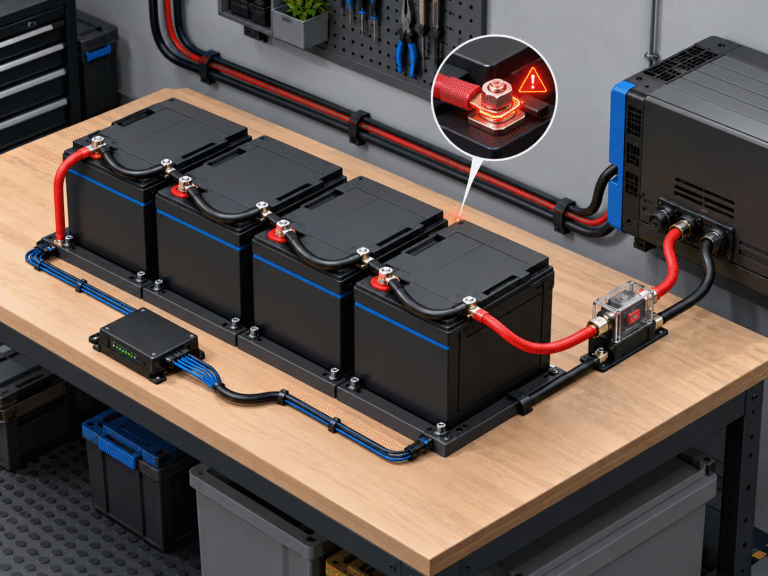
A very common question from solar users, RV owners, marine installers and battery distributors is: “Can I connect four 12.8V LiFePO4 batteries in series and use them as a 48V battery bank?” From a simple voltage calculation, the answer appears obvious.
Four 12.8V batteries connected in series provide a nominal voltage of approximately 51.2V, which is commonly used with equipment marketed as 48V systems. However, this does not mean that every 12.8V LiFePO4 battery can safely be used this way. The cells inside the battery, the BMS design, maximum series quantity, charger settings, insulation requirements and system architecture all matter. Understanding these details before installation can prevent repeated BMS shutdowns, charging problems and premature battery imbalance.
What Actually Changes When Batteries Are Connected in Series?
When batteries are connected in series, the positive terminal of one battery connects to the negative terminal of the next. The voltages add together while the amp-hour capacity remains approximately the same.
For example:
- 1 × 12.8V 100Ah = 12.8V 100Ah
- 2 × 12.8V 100Ah in series = 25.6V 100Ah
- 4 × 12.8V 100Ah in series = 51.2V 100Ah
The nominal energy of four batteries is approximately: 51.2V × 100Ah = 5.12kWh. This is electrically different from connecting four batteries in parallel. Four 12.8V 100Ah batteries in parallel would remain a 12.8V system but provide approximately 400Ah.
Why the Battery BMS Must Support Series Operation
This is one of the most important points and one of the most frequently misunderstood. A 12.8V LiFePO4 battery containing a BMS is not simply four cells in a plastic box. The BMS may monitor and control:
- cell overvoltage;
- cell undervoltage;
- charge overcurrent;
- discharge overcurrent;
- short circuit;
- high temperature;
- low-temperature charging;
- MOSFET or contactor switching.
When several complete batteries are connected in series, each BMS operates at a different electrical potential within the full battery string. The battery manufacturer must therefore design or approve the product for the intended series configuration.
Some 12.8V LiFePO4 batteries may support two, three or four batteries in series. Other models may be intended for parallel use only. Never assume that “12V LiFePO4” automatically means “4S external connection allowed.” The product specification should explicitly state the permitted series quantity.
A 48V Inverter Is Not Always a Perfect Match for Four 12.8V Batteries
The term “48V inverter” describes a nominal system category, not one universal voltage range. Two 48V inverters can have significantly different:
- low-voltage shutdown settings;
- restart voltage;
- charging voltage;
- float voltage;
- maximum charging current;
- battery detection logic.
The battery supplier and inverter specification should therefore be checked together. The key question is not simply: “Is this a 48V inverter?”
A better question is: “Does the inverter’s actual DC operating and charging range match the full operating range of this four-battery LiFePO4 string?”
Why Charging Voltage Needs More Attention in a Series Bank
Each 12.8V LiFePO4 battery contains multiple internal cells and has its own recommended charging limits. When four batteries are connected in series, the charger sees the total bank voltage. However, the total voltage does not reveal how that voltage is distributed across the four batteries.
Imagine four batteries approaching full charge. Their individual voltages might not remain perfectly identical. One battery may reach its BMS charge-protection limit earlier than the others. The charger only sees the total string voltage, but the first BMS to reach its protection threshold may interrupt charging. The result can be confusing:
- the total bank does not appear fully charged;
- the inverter stops charging;
- one battery has a higher voltage than the others;
- SOC values become increasingly different.
This is one reason batteries used in series should begin from closely matched conditions.
Why Individual Battery Voltage Should Be Checked
In a series bank, measuring only the total voltage can hide important information. Suppose a four-battery string measures a total voltage that looks normal. That does not prove that every battery is healthy. For illustration, one battery could be operating at a lower voltage while another is unusually high, yet the total still appears reasonable.
For troubleshooting, measure:
- Battery 1 voltage;
- Battery 2 voltage;
- Battery 3 voltage;
- Battery 4 voltage;
- total string voltage.
If the BMS provides Bluetooth or monitoring data, also compare individual battery and cell information. This is especially useful when the system repeatedly stops charging or shuts down earlier than expected during discharge.
Why You Should Not Connect a 12V Load to One Battery in the String
This mistake is surprisingly common. A user builds a four-battery 48V bank but still needs 12V for lighting, a control system, refrigerator or other auxiliary equipment. It may seem convenient to connect the 12V equipment directly across the terminals of one battery.
This creates unequal discharge. One battery is now supplying both:
- the main 48V system current; and
- the additional 12V auxiliary load.
Over time, that battery becomes more deeply discharged than the other three. The series string becomes increasingly unbalanced, and the lower battery may reach BMS undervoltage protection before the rest of the bank. If a lower auxiliary voltage is required, an appropriately designed DC-DC converter should normally be used from the complete battery bank rather than tapping one battery.
What Happens If One Battery’s BMS Turns Off?
Series-connected batteries all carry the same main current path. If one battery BMS opens its discharge circuit because of:
- low cell voltage;
- overcurrent;
- high temperature;
- short-circuit protection;
- another protection condition,
the current path through the entire series bank may be interrupted. The inverter can then lose battery power even if the other three batteries still contain significant energy. This differs fundamentally from many parallel systems, where other branches may temporarily continue operating after one battery disconnects. For this reason, the reliability behavior of a series bank must be considered at system level.
Can Different Capacity Batteries Be Used in Series?
Consider connecting:
- 12.8V 100Ah;
- 12.8V 100Ah;
- 12.8V 100Ah;
- 12.8V 200Ah.
The total nominal voltage can still appear correct. But the usable string capacity will not become 125Ah or 200Ah simply because one battery is larger. The smaller-capacity batteries generally determine the usable series-string capacity. More importantly, the batteries may reach charge and discharge limits at different times. For predictable performance, series batteries should normally be matched in model, capacity, BMS design and condition.
Can Old and New Batteries Be Connected in Series?
This is also undesirable without careful evaluation. After several years of service, an older battery may have:
- lower usable capacity;
- higher internal resistance;
- greater cell imbalance;
- different BMS calibration.
When placed in series with a new battery, the older unit may become the limiting element of the entire string. A battery string is often limited by its weakest member. This is why replacement strategy is more complicated in a series bank than simply replacing whichever battery has the lowest terminal voltage. The whole string condition should be evaluated.
Does the Same Current Flow Through Every Battery?
Yes, in a simple series circuit the main current flows through each battery. If a 51.2V series bank supplies 50A to an inverter, approximately 50A passes through each series-connected battery. This has an important consequence. Connecting four 12.8V batteries in series increases voltage, but it does not multiply the BMS current rating by four.
If each battery has a 100A continuous discharge BMS, the series bank should not be treated as a 400A system. The current still passes through every individual battery and every BMS. This is a common misunderstanding when users compare series and parallel configurations.
Higher Voltage Can Reduce DC Current for the Same Power
There is also an important advantage to higher-voltage battery systems. For approximately the same inverter power, increasing DC voltage reduces current. For example, ignoring conversion losses: A 2,000W load on a 12.8V system requires roughly four times the current of the same power on a 51.2V system.
Lower current can help reduce:
- cable size requirements;
- voltage drop;
- connector heating;
- busbar current;
- I²R losses.
This is one reason 48V-class systems are widely used for larger solar and off-grid installations. However, higher voltage also requires electrical equipment with appropriate DC voltage ratings.
What About Communication Between Series Batteries?
Communication is one of the areas where users should avoid assumptions. A battery may provide Bluetooth, RS485 or CAN communication when operating individually, but this does not automatically mean several batteries can communicate correctly when externally connected in series.
The communication ports may have grounding, isolation or architecture limitations. For this reason, the manufacturer should confirm:
- whether communication is allowed in series;
- which battery communicates with the inverter;
- whether galvanic isolation is required;
- whether battery-to-battery communication is supported;
- whether only local Bluetooth monitoring should be used.
Electrical series capability and communication capability are not the same thing.
Series-Connected 12.8V Batteries or One Native 51.2V Battery?
For some projects, four separate 12.8V batteries provide advantages such as easier transportation and flexible replacement. For other projects, a factory-designed 51.2V battery may be simpler.
A native 51.2V battery can integrate:
- all cells under one BMS;
- centralized SOC calculation;
- inverter communication;
- internal balancing;
- unified protection;
- fewer external power connections.
This is particularly attractive for residential ESS, commercial storage and larger inverter applications. On the other hand, 12.8V batteries may remain practical for applications requiring modularity or where the same battery platform is used across 12V, 24V and 48V systems. The correct choice depends on application architecture rather than voltage alone.
Before Building a 48V Bank, Ask These Questions
Before ordering four 12.8V batteries for series use, confirm:
- Does the exact battery model support four units in series?
- What is the maximum permitted series voltage?
- What charging voltage is recommended for the complete string?
- What is the maximum continuous charge current?
- What is the maximum continuous discharge current?
- Is inverter communication required?
- Does communication work in series?
- What inverter DC voltage range is required?
- Does the system need any 12V or 24V auxiliary loads?
- Will future capacity expansion be required?
These questions are far more useful than simply asking whether the battery is “12V LiFePO4.”
Frequently Asked Questions
Do four 12.8V batteries make a 48V battery?
Four 12.8V nominal batteries in series create a nominal 51.2V battery bank, commonly used in equipment classified as 48V systems.
Can any 12V lithium battery be connected in series?
No. The battery manufacturer must confirm that the BMS and battery design support the required series quantity.
Does four 100Ah batteries in series become 400Ah?
No. Four 12.8V 100Ah batteries in series create approximately 51.2V 100Ah, not 51.2V 400Ah.
Can I take 12V from one battery in a 48V series bank?
It should generally be avoided because it causes unequal discharge. Use a suitable DC-DC converter when a lower auxiliary voltage is required.
If one series battery shuts down, will the others continue powering the inverter?
Usually the series current path is interrupted when one battery BMS opens, so the entire battery string may stop supplying power.
Final Thoughts
Connecting four LiFePO4 batteries in series is more than a voltage calculation.
The batteries must be designed for series operation, matched to each other, correctly charged and compatible with the inverter’s real voltage range.
Users should also understand that a series bank behaves differently from a parallel bank: the same current flows through every battery, one BMS can interrupt the entire string, and tapping individual batteries for lower-voltage loads can create severe imbalance. For installers and distributors, confirming these points before ordering greatly reduces commissioning problems and warranty disputes.
HIZN Lithium supplies 12.8V, 25.6V, 48V and 51.2V LiFePO4 battery solutions for solar, UPS, telecom, RV, marine and off-grid energy storage applications. If you are considering a series-connected battery bank, send us the required system voltage, inverter model, inverter power, charging source and battery quantity. We can help determine whether a series configuration or a native 48V/51.2V battery solution is more suitable for the project.