
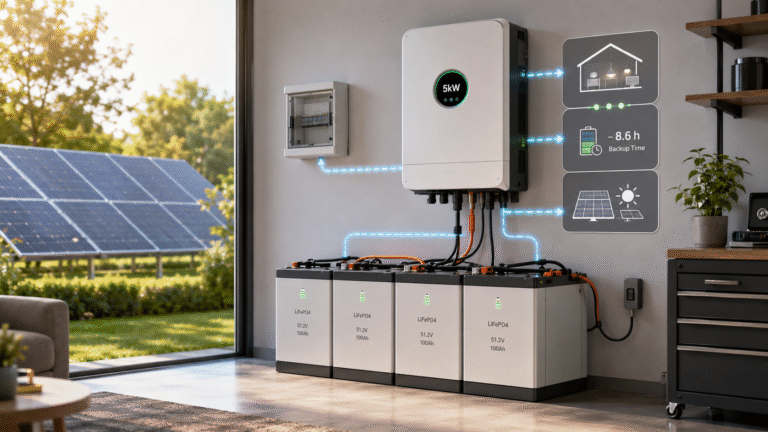
Introduction
One of the most common questions from homeowners and solar installers is:
“How many LiFePO4 batteries do I need for a 5kW hybrid inverter?”
Unfortunately, there is no single answer.
Some homes operate comfortably with a 5.12kWh battery, while others require 20kWh or more.
The correct battery size depends on:
- Your daily electricity consumption
- Which appliances need backup
- Expected backup duration
- Solar panel capacity
- Local climate
- Frequency of power outages
This guide explains how professional installers determine the right battery size instead of relying on guesswork.
First, Understand What “5kW” Really Means
A common misconception is that a 5kW inverter requires a 5kWh battery.
These two numbers describe completely different things.
- 5kW is the maximum power the inverter can deliver at one moment.
- kWh measures how much energy the battery stores.
Think of it this way:
- kW = Speed
- kWh = Fuel Tank
A larger engine does not automatically require a larger fuel tank. Likewise, a 5kW inverter does not automatically require a 5kWh battery.
Step 1 – Calculate Your Night-Time Energy Consumption
The battery’s primary job is usually to power loads after sunset or during grid outages.
List the appliances you want to keep running and estimate how much energy they use overnight.
Example:
| Appliance | Power | Operating Time | Daily Energy |
|---|---|---|---|
| Refrigerator | 180W | 10h | 1.8kWh |
| LED Lighting | 120W | 6h | 0.72kWh |
| Television | 100W | 4h | 0.40kWh |
| Wi-Fi Router | 20W | 12h | 0.24kWh |
| Security Cameras | 40W | 12h | 0.48kWh |
| Fan | 75W | 8h | 0.60kWh |
Total overnight energy demand:
4.24kWh
In this scenario, a 5.12kWh LiFePO4 battery would generally provide sufficient overnight backup while leaving a small operating reserve.
Step 2 – Decide How Long You Need Backup
The required backup time varies significantly by region.
Areas with Stable Utility Power
If outages are infrequent and short, a battery sized for 4–6 hours of essential loads may be sufficient.
Areas with Daily Load Shedding
In regions where scheduled outages occur every day, many homeowners prefer enough storage to cover the entire evening and overnight period.
Off-Grid Homes
For off-grid systems, battery capacity is typically designed to provide at least one full day of autonomy, with additional reserve depending on local weather conditions.
Typical Battery Configurations for a 5kW Hybrid Inverter
The following examples illustrate common battery sizes paired with a 5kW inverter.
| Battery Configuration | Nominal Energy | Typical Applications |
| 1 × 51.2V 100Ah | 5.12kWh | Apartments, small homes, lighting and essential loads |
| 2 × 51.2V 100Ah | 10.24kWh | Average family homes, longer overnight backup |
| 2 × 51.2V 200Ah | 20.48kWh | Villas, frequent outages, high self-consumption |
| 3 × 51.2V 200Ah | 30.72kWh | Off-grid homes, small businesses, long backup duration |
These are typical examples only. Final sizing should always be based on actual energy consumption and project requirements.
Real Project Example – Nigeria
Customer Profile
- Three-bedroom house
- 5kW hybrid inverter
- Frequent grid outages
- Rooftop solar PV system
Essential Loads
- Refrigerator
- Lighting
- Television
- Wi-Fi
- Water pump
- Security cameras
Average overnight consumption:
Approximately 7.5kWh
Recommended Battery
2 × 51.2V 100Ah LiFePO4 batteries
This provides approximately 10.24kWh nominal storage, offering sufficient reserve for normal overnight operation and occasional higher demand.
Real Project Example – Saudi Arabia
Customer Profile
Villa with significant evening cooling demand.
Nighttime loads included:
- Two inverter air conditioners
- Indoor lighting
- Refrigerator
- Internet
- Security system
Estimated overnight energy requirement:
Approximately 16–18kWh
Recommended Battery
2 × 51.2V 200Ah LiFePO4 batteries
This configuration allows extended nighttime operation while reducing the depth of discharge during daily cycling.
Can One Battery Run a 5kW Inverter?
Technically, yes.
Whether one battery is sufficient depends on both:
- Its energy capacity (kWh)
- Its maximum continuous discharge current
For example, a 51.2V 100Ah battery stores approximately 5.12kWh and may support a continuous output of around 5kW, depending on the battery’s specifications.
However, if the connected load approaches the inverter’s full output for an extended period, backup time will be limited.
Always check the battery manufacturer’s current ratings before designing the system.
Common Mistakes
Choosing a Battery Based Only on Inverter Size
A 5kW inverter does not automatically require a 5kWh battery.
Battery capacity should be based on energy demand, not inverter rating.
Ignoring Future Expansion
Many homeowners later add:
- Additional air conditioners
- Freezers
- Electric cooking appliances
- Electric vehicles
Selecting a battery system that supports parallel expansion simplifies future upgrades.
Not Checking Battery Current Capability
Even if the battery stores enough energy, it must also support the inverter’s maximum charge and discharge current.
Verify these values before installation.
Buying the Cheapest Battery
A lower purchase price may not represent the lowest lifetime cost.
Consider:
- Cycle life
- Warranty
- Communication compatibility
- Service support
- Manufacturer reputation
rather than price alone.
HIZN Engineer’s Recommendation
When selecting batteries for a 5kW hybrid inverter, avoid starting with the inverter specification.
Instead, gather the following information:
- Daily electricity consumption
- Essential backup loads
- Expected backup duration
- Solar panel capacity
- Location and climate
- Future expansion plans
This approach ensures the battery is matched to the customer’s actual needs rather than to a single equipment rating.
Frequently Asked Questions
Can I use two different battery capacities together?
It is generally recommended to use batteries of the same model, capacity, and production batch whenever possible. Mixing different capacities can lead to imbalanced charging and discharging.
Is one 5.12kWh battery enough?
For some apartments and small homes, yes. Larger households or regions with long outages usually require additional storage.
Can I add more batteries later?
Many modular LiFePO4 systems support parallel expansion, provided the manufacturer’s requirements are followed.
Conclusion
There is no universal battery size for a 5kW hybrid inverter.
The correct configuration depends on how much energy your home actually uses and how long you expect the battery to provide backup power.
By evaluating real energy consumption, planning for future expansion, and selecting batteries with appropriate capacity and current ratings, homeowners and installers can build a reliable ESS that balances performance, cost, and long-term flexibility.