
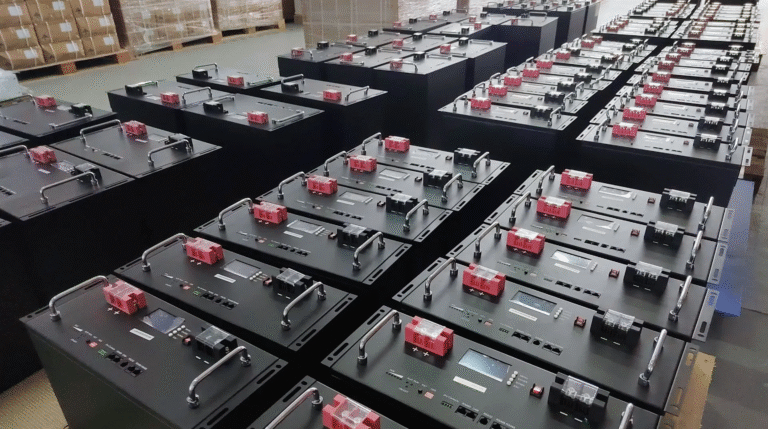
1. Why Choosing the Right Battery Matters
Choosing the wrong battery for your energy storage system can lead to:
- Insufficient backup time
- Short battery lifespan
- System incompatibility
- Unexpected replacement costs
For solar, telecom, or UPS applications, your battery is not just a component — it’s the core of your energy system.
That’s why more buyers are switching to LiFePO4 batteries due to:
- Longer cycle life (4000–6000 cycles)
- Higher safety compared to other lithium chemistries
- Lower long-term cost
But here’s the problem:
👉 Not all lithium batteries are the same.
2. Step 1: Understand Your Application Scenario
Before selecting any battery, you must define your use case:
Home Solar Storage
- Daily cycling
- Medium capacity (5–20 kWh)
- Focus: lifespan + efficiency
Off-Grid Systems
- Deep discharge required
- High reliability
- Focus: durability + autonomy
Telecom Base Stations
- Long backup time
- Stable output
- Focus: reliability + temperature resistance
UPS Backup
- Short discharge time
- Instant response
- Focus: power stability
👉 Different applications require completely different battery configurations.
3. Step 2: Choose the Right Battery Capacity (Ah / kWh)
Battery capacity determines how long your system can run.
Basic formula:
Battery Capacity (kWh) = Load (kW) × Backup Time (hours)
Example:
- Load: 2 kW
- Backup time: 5 hours
👉 Required capacity = 10 kWh
But in real applications, you must consider:
- Depth of Discharge (DoD)
- System losses
- Future expansion
👉 So the actual recommended capacity is usually 20–30% higher.
4. Step 3: Select the Correct Voltage (12V / 24V / 48V / 51.2V)
Voltage selection affects system efficiency and compatibility.
General recommendation:
- Small systems → 12V / 24V
- Residential solar → 48V
- Commercial systems → 51.2V (industry standard)
Why 51.2V is popular:
- Matches most inverters
- Higher efficiency
- Lower current → less heat loss
👉 Choosing the wrong voltage can cause system mismatch.
5. Step 4: Check Cycle Life & Depth of Discharge (DoD)
These two factors determine your real ROI.
Typical values:
- Cycle life: 4000–6000 cycles
- Recommended DoD: 80–90%
Key insight:
A cheaper battery with low cycle life may cost more over time.
👉 Always evaluate cost per cycle, not just purchase price.
6. Step 5: Understand BMS (Battery Management System)
The BMS is the “brain” of the battery.
A good BMS provides:
- Overcharge / over-discharge protection
- Temperature control
- Cell balancing
- Communication with inverter
👉 Without a reliable BMS, even a good battery can fail early.
7. Step 6: Check Certifications & Safety Standards
For international projects, certifications are critical.
Common certifications:
- UN38.3 (transport safety)
- CE (EU compliance)
- IEC standards
- MSDS
👉 Lack of certification = potential project rejection.
8. Step 7: Evaluate the Supplier (Very Important)
Many buyers overlook this — and regret it later.
A reliable supplier should offer:
- Real manufacturing capability (not trading only)
- Project experience (solar / telecom / UPS)
- Technical support
- Custom battery solutions
👉 The battery is a long-term investment — supplier quality matters as much as product quality.
9. Common Buying Mistakes to Avoid
- Choosing based on price only
- Ignoring system compatibility
- Undersizing battery capacity
- Not considering future expansion
- Buying without technical consultation
10. Conclusion: How to Make the Right Choice
To choose the right LiFePO4 battery, you should:
- Define your application
- Calculate required capacity
- Choose proper voltage
- Evaluate cycle life & DoD
- Check BMS and certifications
- Work with a reliable supplier
📩 Get a Free Battery Configuration (High Conversion CTA)
Not sure which battery is right for your project?
We can help you design the best solution based on:
- Your load (kW)
- Backup time
- Solar system configuration
- Budget
👉 Contact us now for a free customized battery solution
👉 WhatsApp / Email response within 24 hours