
Introduction
One of the first questions every homeowner, solar installer, EPC contractor, and battery distributor asks before purchasing a lithium battery is:
How long will a LiFePO4 battery actually last?
It is a simple question, but the answer is far more complex than the marketing claims often seen on product brochures.
Some manufacturers advertise:
- 4,000 cycles
- 6,000 cycles
- 8,000 cycles
- 10,000 cycles
Others promote warranties of:
- 5 years
- 10 years
- 15 years
These figures can be confusing because cycle life and calendar life describe two very different aspects of battery aging.
A battery may still have thousands of cycles remaining but reach the end of its useful life due to aging. Likewise, a battery used every day may eventually lose capacity even though it has been stored under ideal environmental conditions.
To make informed purchasing decisions, buyers need to understand:
- What cycle life actually means
- How manufacturers measure battery lifespan
- Why two batteries with identical specifications may age differently
- Which environmental and operational factors shorten or extend battery life
- How to maximize the lifespan of a LiFePO4 battery
This chapter provides a practical and engineering-based explanation of LiFePO4 battery lifespan, helping both professionals and end users evaluate batteries beyond simple marketing specifications.
Why Battery Lifespan Matters More Than Purchase Price
When comparing batteries, many buyers focus on the initial purchase price.
However, professional project developers rarely evaluate batteries this way.
Instead, they ask a different question:
How much will this battery cost over its entire service life?
This concept is known as the Total Cost of Ownership (TCO).
For example:
Battery A costs:
US$2,000
and lasts:
5 years.
Battery B costs:
US$3,000
and lasts:
15 years.
Although Battery B requires a larger initial investment, it may eliminate one or two replacement cycles over the life of the solar system.
When installation labor, transportation, downtime, and maintenance are included, the battery with the higher purchase price often becomes the more economical option.
This is one of the primary reasons why LiFePO4 batteries have become the preferred technology for residential ESS, telecom backup systems, commercial storage, and industrial energy projects.
Two Different Ways to Measure Battery Lifespan
Battery lifespan is generally evaluated using two complementary metrics:
- Cycle Life
- Calendar Life
These terms are often confused, but they describe different aging mechanisms.
What Is Cycle Life?
Cycle life measures how many complete charge and discharge cycles a battery can perform before its available capacity declines to a specified level—typically 80% of its original rated capacity.
A cycle is not simply charging the battery once.
Instead, it represents the total amount of energy equivalent to one full discharge and one full recharge.
For example:
- Discharging from 100% to 0% and recharging back to 100% equals one full cycle.
- Discharging from 100% to 50% and then recharging to 100% equals half a cycle.
- Repeating that half-cycle twice equals one equivalent full cycle.
This distinction is important because most residential energy storage systems do not fully discharge every day.
Visualizing Battery Cycling
Imagine a homeowner who uses a battery primarily during the evening.
Each day:
- The battery is charged by solar panels during daylight hours.
- Approximately 40–60% of the stored energy is used overnight.
- The battery is recharged the following morning.
Although the battery is used daily, it may accumulate only one equivalent full cycle every two or three days depending on the depth of discharge.
As a result, the real-world service life can exceed simple cycle-life calculations.
Typical LiFePO4 Cycle Life
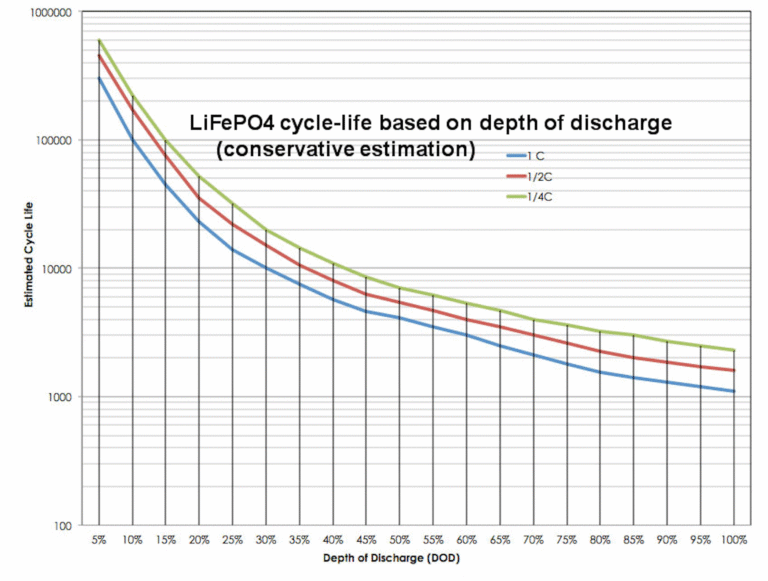
The expected cycle life depends on several variables, including:
- Cell quality
- Depth of discharge
- Temperature
- Charging voltage
- Charging current
- Battery management system (BMS)
Typical values are shown below.
| Battery Chemistry | Typical Cycle Life* |
|---|---|
| Flooded Lead-Acid | 500–1,000 |
| AGM | 600–1,200 |
| GEL | 800–1,500 |
| OPzS | 1,800–3,000 |
| OPzV | 2,000–3,500 |
| LiFePO4 | 4,000–8,000+ |
*Values are representative ranges under manufacturer-defined test conditions and vary by product design and operating environment.
These figures illustrate why LiFePO4 batteries are particularly well suited for daily cycling applications such as solar energy storage.
What Does “80% Remaining Capacity” Mean?
A common misconception is that a battery “fails” after reaching its rated cycle life.
In reality, manufacturers generally define end of cycle life as the point at which the battery retains approximately:
80%
of its original capacity.
For example:
A battery originally rated at:
10 kWh
may still provide approximately:
8 kWh
after completing its rated number of cycles.
The battery continues to operate, but its usable energy storage has gradually decreased.
For many applications, especially stationary energy storage, this remaining capacity may still be entirely acceptable.
Capacity Fade Is Gradual
Battery aging is not a sudden event.
Instead, capacity decreases gradually over time.
A simplified illustration:
| Service Stage | Approximate Available Capacity |
| New Battery | 100% |
| Mid-Life | 95–90% |
| Mature Operation | 90–85% |
| Rated End of Cycle Life | ~80% |
Because degradation is progressive, users often do not notice changes during the early years of operation.
What Is Calendar Life?
Cycle life describes wear caused by battery use.
Calendar life describes aging caused simply by the passage of time.
Even if a battery is rarely used, chemical reactions continue to occur inside the cells.
These slow reactions gradually influence:
- Internal resistance
- Electrolyte condition
- Electrode structure
- Available capacity
As a result, every battery has a practical calendar life regardless of usage.
Why Calendar Life Is Important
Consider two identical batteries.
Battery A
Installed in a home ESS.
Used every day.
Battery B
Stored in a warehouse.
Never cycled.
After ten years, both batteries have aged.
Although Battery B has completed very few cycles, it has still experienced chemical aging.
This demonstrates why calendar life must always be considered alongside cycle life.
Typical Calendar Life of LiFePO4 Batteries
Under recommended operating conditions, many high-quality LiFePO4 batteries achieve:
- 10 years
- 15 years
- or even longer
Actual service life depends heavily on:
- Average operating temperature
- Storage conditions
- Charging practices
- Cell quality
- BMS performance
Unlike cycle life, calendar life is influenced more by environmental exposure than by the number of charge-discharge events.
Cycle Life vs Calendar Life: Which Matters More?
The answer depends on the application.
Residential Solar Storage
Daily cycling means cycle life is often the dominant consideration.
Telecom Backup Systems
Where batteries may remain on standby for long periods, calendar life becomes equally important.
Commercial ESS
Both cycle life and calendar life have major financial implications because systems operate for many years while also cycling frequently.
For this reason, professional project developers evaluate both metrics when comparing battery technologies.
Why Published Cycle-Life Numbers Can Be Misleading
When comparing specifications, buyers often see dramatically different claims:
- 4,000 cycles
- 6,000 cycles
- 8,000 cycles
- 10,000 cycles
These numbers cannot be compared directly unless the test conditions are also known.
Important questions include:
- At what depth of discharge was the test performed?
- What ambient temperature was maintained?
- What charging current was used?
- What discharge current was used?
- What capacity retention threshold defined end of life?
- Which international testing standard was followed?
Without this information, cycle-life figures should be interpreted carefully.
Professional buyers should request detailed test reports rather than relying solely on headline numbers.
Key Takeaways
Battery lifespan cannot be described using a single number.
Understanding the difference between cycle life and calendar life is essential when evaluating long-term battery performance.
For most solar energy storage applications, LiFePO4 batteries offer a significant advantage because they combine:
- Long cycle life
- Long calendar life
- Stable capacity retention
- Predictable long-term performance
However, lifespan also depends heavily on how the battery is designed, manufactured, installed, and operated.
In the next section, we will examine the engineering factors that have the greatest impact on LiFePO4 battery lifespan—including temperature, depth of discharge, charging behavior, C-rate, and Battery Management System (BMS) design.