
Introduction
Safety has become one of the most important considerations when selecting an energy storage system.
As lithium batteries become increasingly common in homes, businesses, telecommunications networks, hospitals, factories, and utility-scale energy storage projects, buyers are asking a critical question:
How safe are lithium batteries?
Media reports about battery fires have raised public awareness, but they have also created confusion.
Many people assume that all lithium batteries behave the same way.
In reality, this is not the case.
The term “lithium battery” covers several different chemistries, each with unique characteristics, performance profiles, and safety behavior.
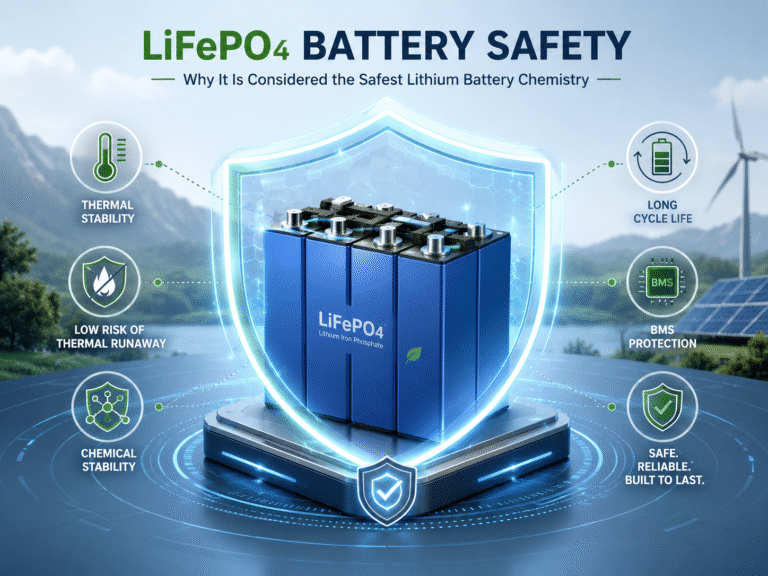
Among these technologies, Lithium Iron Phosphate (LiFePO4) has earned a strong reputation for its thermal stability, chemical robustness, and predictable performance.
For this reason, LiFePO4 has become the preferred chemistry for:
- Residential Energy Storage Systems (ESS)
- Commercial & Industrial ESS
- Telecom Backup Power
- UPS Systems
- Off-Grid Solar Projects
- Battery Energy Storage Systems (BESS)
This chapter explains why LiFePO4 batteries are widely regarded as one of the safest lithium battery technologies available today, and what additional design, manufacturing, and installation factors contribute to a safe energy storage system.
Understanding Battery Safety
Battery safety is not determined by a single feature.
Instead, it is the result of multiple layers of protection working together.
A safe battery system combines:
- Stable battery chemistry
- High-quality battery cells
- Intelligent Battery Management System (BMS)
- Reliable mechanical design
- Proper thermal management
- Robust electrical protection
- Correct installation practices
- Compliance with international safety standards
If any one of these layers is compromised, overall system safety can be affected.
Not All Lithium Batteries Are the Same
One of the biggest misconceptions in the energy storage industry is treating all lithium batteries as if they were identical.
In reality, several lithium-ion chemistries are commercially available.
The most common include:
| Chemistry | Typical Applications |
|---|---|
| LiFePO4 (Lithium Iron Phosphate) | Energy Storage, Telecom, UPS |
| NMC (Nickel Manganese Cobalt) | Electric Vehicles |
| NCA (Nickel Cobalt Aluminum) | Electric Vehicles |
| LCO (Lithium Cobalt Oxide) | Consumer Electronics |
| LMO (Lithium Manganese Oxide) | Power Tools |
| LTO (Lithium Titanate) | Specialized Industrial Systems |
Each chemistry offers different advantages.
Some prioritize:
- energy density
- lightweight construction
Others prioritize:
- safety
- long lifespan
- thermal stability
For stationary energy storage, safety and reliability are generally more important than achieving the highest possible energy density.
Why Chemistry Matters
The cathode material largely determines how a battery behaves under stress.
It influences:
- Heat generation
- Structural stability
- Oxygen release
- Thermal runaway resistance
- Cycle life
- Temperature tolerance
LiFePO4 chemistry forms a highly stable crystal structure.
This stability makes it significantly more resistant to thermal decomposition than many cobalt-based lithium chemistries.
As a result, LiFePO4 batteries are less likely to experience uncontrolled temperature escalation when operated within their specified limits.
What Is Thermal Stability?
Thermal stability refers to a material’s ability to remain chemically stable as temperature increases.
A battery with high thermal stability:
- resists decomposition
- generates less heat internally
- tolerates elevated temperatures more effectively
- is less likely to release oxygen from the cathode
These characteristics contribute to safer operation in demanding environments.
LiFePO4 chemistry is widely recognized for its excellent thermal stability, which is one reason it is commonly selected for stationary energy storage applications.
What Is Thermal Runaway?
One of the most discussed topics in battery safety is thermal runaway.
Thermal runaway is a chain reaction in which rising battery temperature accelerates internal chemical reactions, generating additional heat.
If this heat cannot be dissipated, temperature continues increasing rapidly.
Depending on the battery chemistry and system design, thermal runaway may lead to:
- venting of gases
- smoke generation
- fire
- propagation to adjacent cells
Thermal runaway is a complex phenomenon influenced by many factors, including battery chemistry, mechanical damage, manufacturing quality, charging conditions, and protective system design.
Why LiFePO4 Is More Resistant to Thermal Runaway
Compared with several other lithium-ion chemistries, LiFePO4 offers greater resistance to thermal runaway because of its strong phosphate crystal structure.
This structure:
- remains stable at higher temperatures
- binds oxygen more securely within the cathode
- slows decomposition under abnormal conditions
As a result, LiFePO4 cells generally require significantly higher temperatures before entering severe thermal instability compared with many cobalt-based lithium batteries.
This does not mean that LiFePO4 batteries are immune to failure.
Rather, it means they provide a larger safety margin when combined with proper engineering controls.
Common Causes of Battery Safety Incidents
Most battery safety incidents are not caused by chemistry alone.
Instead, they typically involve one or more abnormal conditions.
Examples include:
Mechanical Damage
Severe impact or crushing may damage internal structures.
Electrical Abuse
Examples include:
- overcharging
- over-discharging
- external short circuits
- reverse polarity
Manufacturing Defects
Poor manufacturing quality may increase the likelihood of internal failures.
Improper Installation
Examples include:
- undersized cables
- loose electrical connections
- inadequate ventilation
- incorrect inverter settings
Incompatible Components
Using batteries with unsupported chargers or inverters may result in abnormal operating conditions.
The Multiple Layers of Protection
Modern LiFePO4 battery systems are designed using multiple independent safety layers.
These layers typically include:
Cell-Level Safety
Each battery cell is manufactured under strict quality control procedures.
Manufacturers evaluate:
- capacity consistency
- internal resistance
- voltage matching
before battery assembly.
Module-Level Protection
Battery modules incorporate:
- insulation
- mechanical reinforcement
- structural supports
to reduce the effects of vibration and mechanical stress.
Battery Pack Protection
At the pack level, additional components provide:
- fuse protection
- contactors
- current sensing
- voltage monitoring
- temperature monitoring
Battery Management System (BMS)
The BMS continuously supervises battery operation.
Typical functions include:
- over-voltage protection
- under-voltage protection
- over-current protection
- temperature monitoring
- cell balancing
- fault detection
- communication with the inverter
The BMS serves as the central control system responsible for maintaining battery operation within its intended design limits.
Why Professional Manufacturing Matters
Battery safety begins long before installation.
It starts with:
- engineering design
- material selection
- manufacturing processes
- quality control
- testing procedures
Professional manufacturers typically implement:
- incoming material inspection
- automated welding
- electrical testing
- insulation testing
- aging tests
- final functional inspection
These quality-control steps help ensure consistent performance and reduce the likelihood of manufacturing-related defects.
Key Takeaways
LiFePO4 batteries are widely recognized as one of the safest lithium battery technologies for stationary energy storage because of their stable chemistry and suitability for layered safety design.
However, battery safety depends on the entire system—not only on the cell chemistry itself.
A safe energy storage solution combines:
- High-quality cells
- Intelligent BMS
- Robust mechanical design
- Correct installation
- Proper operating parameters
- Compliance with international safety standards
In the next section, we will explore how Battery Management Systems, thermal protection, electrical safeguards, and fault detection work together to protect modern LiFePO4 battery systems under real-world operating conditions.