
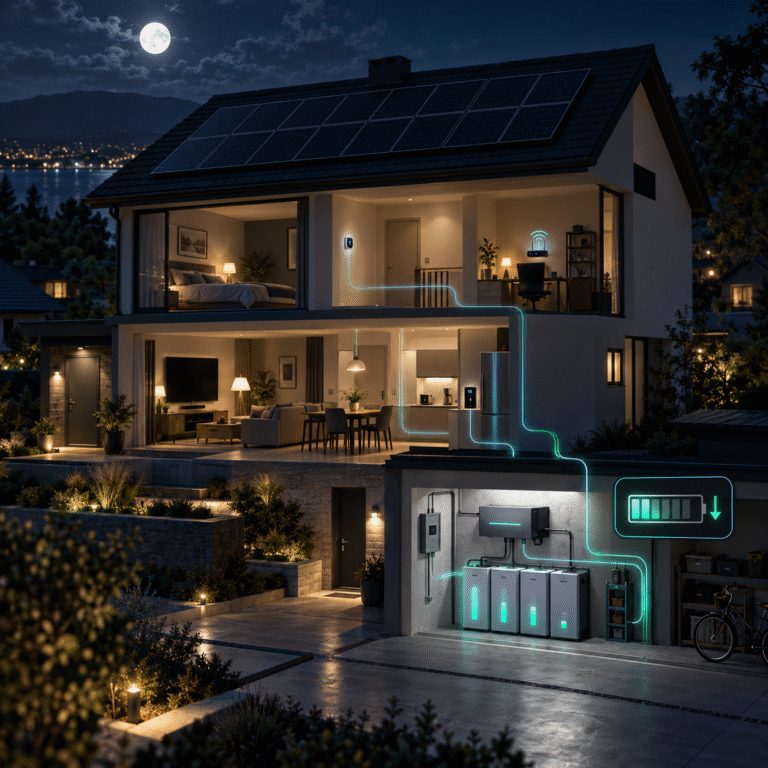
Introduction
The solar panels stop producing power after sunset.
Most household loads are switched off.
Yet the next morning, the LiFePO4 battery has dropped from: 80% SOC to 76%
or: 60% to 57%
The customer immediately asks:
“Where did the energy go?”
The first suspicion is often battery self-discharge.
But in a complete solar energy storage system, the battery can continue supplying small amounts of power all night even when no obvious appliance is running.
Possible consumers include:
- Hybrid inverter standby power
- MPPT charge controller
- Battery BMS
- Wi-Fi or monitoring modules
- LCD displays
- Contactors
- Communication gateways
- DC loads
- Security systems
- Metering equipment
There is also another question frequently raised by users:
Can solar panels or the MPPT controller drain the battery backwards at night?
The answer depends on the controller design, but a correctly designed solar charge controller should prevent significant reverse current into the PV array.
Therefore, unexplained overnight SOC loss should be diagnosed systematically rather than immediately blaming the battery cells.
A Solar System Never Really Becomes “Off”
A customer may say:
“Nothing is running.”
But electrically, the system can still be active.
A typical solar ESS may contain:
LiFePO4 Battery → BMS → Inverter → Monitoring Electronics
and: LiFePO4 Battery → MPPT Controller
and possibly: LiFePO4 Battery → DC Loads
Even when AC appliances are switched off, many electronic devices remain powered.
Their individual consumption may look small.
Over 10–12 hours, however, the accumulated energy can become noticeable.
Start with Inverter Standby Consumption
The inverter is often the largest hidden overnight consumer.
Even with zero AC load, a hybrid inverter may need power for:
- CPU and control electronics
- Grid synchronization
- Communication
- Display
- Relays
- Cooling control
- Battery monitoring
This is normally called: standby consumption
or: self-consumption
Suppose an inverter consumes: 30W while idle.
Over 12 hours: 30W × 12h = 360Wh
For a 5.12kWh battery: 360Wh ÷ 5120Wh ≈ 7%
before considering other system consumption.
This simple calculation explains why standby power matters much more with smaller battery banks.
A Bigger Battery Shows a Smaller SOC Drop
Consider the same 360Wh overnight consumption.
5.12kWh Battery
360Wh represents approximately: 7%
20kWh Battery
360Wh represents approximately: 1.8%
The inverter consumed the same energy in both systems.
But the displayed SOC drop looks very different.
Therefore, when comparing two systems, do not compare only the percentage drop.
Compare actual energy in: Wh or kWh
where possible.
Battery BMS Also Uses Power
A LiFePO4 battery contains an electronic Battery Management System.
The BMS may continuously monitor:
- Individual cell voltage
- Pack voltage
- Current
- Temperature
- SOC
- Protection status
Depending on the battery, additional electronics may include:
- LCD
- Bluetooth
- Wi-Fi
- RS485
- CAN
- RS232
- LEDs
- Internal contactor circuits
These devices require power.
In a large ESS, the consumption may be relatively insignificant.
But during very long storage or in small battery systems, BMS consumption can become visible.
Sleep Mode Can Reduce Standby Consumption
Some batteries automatically enter: sleep mode
after a period with no significant charge or discharge current.
Others require:
- Main switch off
- Breaker off
- Power button
- Software command
Sleep mode may reduce internal consumption.
However, sleep behavior differs between BMS designs.
Distributors should understand whether their battery:
- Automatically sleeps
- Remains fully active
- Keeps communication modules powered
This matters both for installed systems and warehouse storage.
Does an MPPT Controller Consume Battery Power at Night?
Yes, the controller itself may require a small amount of operating power.
At night, the PV array provides no useful energy.
The MPPT still may need electricity for:
- Controller electronics
- Display
- Communication
- Monitoring
This power may come from the battery.
Usually it is small compared with inverter standby consumption, but it should still be considered in low-power systems.
Can Current Flow Back into the Solar Panels at Night?
This is a common concern.
Without proper blocking, a battery could theoretically send current backward toward a lower-voltage PV circuit.
Modern solar charge controllers are generally designed to prevent significant reverse current.
Depending on architecture, this may be accomplished through:
- MOSFET switching
- Internal blocking circuitry
- Other reverse-current protection
However, equipment design varies.
If abnormal reverse current is suspected, check the controller specification rather than assuming every product behaves identically.
Why Directly Connected PV Would Be Different
A solar panel should not normally be connected directly to a LiFePO4 battery without an appropriate charge controller.
A proper controller provides both:
- Controlled charging
- Electrical isolation/switching behavior needed for system operation
This is another reason MPPT or suitable solar charging equipment is essential.
Hidden DC Loads Are Frequently Missed
A customer may turn off all AC appliances but forget about DC equipment such as:
- CCTV cameras
- Router
- 4G/5G modem
- LED lighting
- Security system
- DC fan
- Alarm system
- Battery cabinet controller
These loads may bypass the inverter’s AC load display.
The inverter could show: 0W load
while the battery is still delivering current to another DC branch.
Always inspect the complete battery bus.
Example: Small Hidden Loads Add Up
Suppose overnight consumption includes:
Inverter standby: 25W
Router: 10W
CCTV: 15W
Battery/monitoring electronics: 5W
Total: 55W
Over 12 hours: 55 × 12 = 660Wh
For a 10.24kWh battery: 660Wh ÷ 10,240Wh ≈ 6.4%
The battery can therefore lose several SOC percentage points without any large appliance operating.
SOC Drop Is Not Always Equal to Energy Loss
Another important issue is BMS SOC estimation.
SOC is not measured directly like temperature.
The BMS normally estimates it using methods such as:
- Coulomb counting
- Current integration
- Voltage reference
- Full-charge synchronization
A displayed change from: 80% → 76%
does not always mean exactly 4% of nominal energy physically disappeared.
SOC calibration can influence the displayed value.
This is especially noticeable after:
- Long standby periods
- Partial cycling
- BMS restart
- Extended operation without full-charge synchronization
Check Battery Current, Not Only SOC
A useful diagnostic question is:
What current is actually leaving the battery overnight?
For example:
Battery current = 0.5A
Battery voltage ≈ 51.2V
Approximate power: 51.2 × 0.5 ≈ 25.6W
Over 10 hours: 25.6 × 10 ≈ 256Wh
This provides a much more useful explanation than simply saying: “SOC dropped 3%.”
Small Current Becomes Significant Over Time
Consider a 51.2V system.
0.2A Standby Current
Power ≈ 10W
Over 24 hours: ≈ 0.24kWh
1A Standby Current
Power ≈ 51W
Over 24 hours: ≈ 1.23kWh
A continuous 1A drain is not small when maintained all day.
This is why standby current matters in:
- Telecom sites
- Seasonal cabins
- Backup-only systems
- Warehouses
Self-Discharge vs Parasitic Load
These two concepts are often confused.
Self-Discharge
Energy is lost internally inside the cells over time.
Parasitic Load
External or internal electronics actively consume battery energy.
If a battery drops noticeably overnight while connected to an operating inverter, parasitic consumption is usually more relevant than cell self-discharge.
To separate them, a controlled test is needed.
How to Perform an Overnight Isolation Test
A useful troubleshooting procedure is:
Test A: Normal System
Record:
- SOC
- battery voltage
- battery current
at night.
Check again in the morning.
Test B: Inverter Off
Repeat with inverter fully shut down according to manufacturer procedure.
Test C: Battery Isolated
If appropriate and permitted, isolate external equipment and observe battery behavior over a longer period.
Comparing these tests helps identify whether the energy loss comes primarily from:
- Battery
- inverter
- controller
- external loads
Do Not Judge Self-Discharge from One Night
If a battery appears to lose SOC during one night, this is not enough to determine cell self-discharge.
SOC estimation error may be larger than the actual cell energy loss during such a short test.
A proper storage test should use:
- Controlled starting SOC
- Known temperature
- Known isolation condition
- Longer observation period
- Voltage and energy records
Inverter “Off” May Still Not Mean Zero Consumption
Many inverters have several states:
- Running
- Standby
- Search mode
- Soft off
- Hard disconnected
Pressing the front-panel power button may stop AC output but leave:
- communication
- display
- controller
- battery interface
active.
Check the inverter manual if the objective is truly minimum battery consumption.
Search Mode Can Help in Some Off-Grid Systems
Some inverters offer a low-power: search mode
When no significant AC load is detected, inverter output is reduced or pulsed.
This may lower standby consumption.
However, search mode can cause problems with very small or sensitive loads.
Examples include:
- electronic timers
- network equipment
- certain chargers
Use it only when compatible with the load profile.
Wi-Fi Monitoring Can Also Consume Energy
Modern ESS systems increasingly include:
- cloud monitoring
- Wi-Fi dongles
- cellular gateways
- data loggers
Their power consumption individually may be modest.
But in a remote installation operating continuously, they become part of the daily energy budget.
For off-grid design, every continuous load should be counted.
Telecom Sites Need Special Attention
Telecom systems often have many continuous small loads.
These include:
- monitoring
- alarm equipment
- communication modules
- rectifier controllers
A battery bank can therefore continue discharging even when the main telecom radio load is reduced.
This is why telecom power design normally uses a complete DC load calculation.
Why Overnight Loss Can Be Worse After Battery Expansion
Interestingly, some users add more battery capacity and then notice that the system still loses energy every night.
The absolute standby energy has not changed.
Only the percentage changed.
Adding battery capacity does not eliminate:
- inverter standby consumption
- communications load
- monitoring load
If the objective is reducing energy loss, improve system standby efficiency rather than only increasing battery capacity.
Reverse Current Test
If you specifically suspect PV reverse current at night, check:
- MPPT night current specification
- Battery current with PV connected
- Battery current with PV isolated
If isolating the PV side produces no meaningful change, the panels are probably not the main source of the drain.
Follow safe DC isolation procedures.
PV DC voltage can remain hazardous even when sunlight is weak.
What If Battery Current Shows Zero but SOC Still Falls?
Possible explanations include:
- Current below display resolution
- SOC recalculation
- BMS calibration
- Internal BMS consumption not measured by the displayed current sensor
- Display rounding
Look at the behavior over several days instead of one reading.
Temperature Can Affect Displayed SOC
Battery voltage and internal behavior change with temperature.
A battery that cools significantly overnight may show a slightly different estimated SOC.
When troubleshooting, record:
- nighttime battery temperature
- morning temperature
especially in outdoor systems.
Alarm Logs Can Reveal Unexpected Wake-Ups
Some systems periodically wake from sleep because of:
- communication requests
- inverter polling
- charger detection
- remote monitoring
The battery therefore may not remain in its lowest-power state all night.
BMS logs and inverter logs can help identify this.
A Practical Diagnostic Checklist
If the battery loses more overnight SOC than expected:
- Record nighttime SOC.
- Record battery voltage.
- Record battery current.
- Check inverter standby consumption.
- Check DC loads.
- Check MPPT standby consumption.
- Check Wi-Fi/monitoring devices.
- Compare BMS SOC with actual Ah/kWh data.
- Repeat with inverter shut down.
- Investigate reverse current only if measurements support it.
For Distributors: Ask for Energy Data
When a customer says:
“The battery loses 5% every night.”
Ask for:
- Battery capacity
- Battery quantity
- Inverter model
- SOC before sleep
- SOC in morning
- Battery current at night
- AC load
- DC load
- Inverter standby specification
- MPPT model
A 5% drop on a 5kWh battery and a 5% drop on a 40kWh battery represent very different amounts of energy.
Example: 51.2V 100Ah Battery
Nominal energy: 51.2 × 100 = 5.12kWh
Suppose overnight system consumption is: 300Wh
Percentage of nominal battery energy: 300 ÷ 5120 ≈ 5.9%
A customer seeing around 6% SOC reduction may therefore have a completely explainable system load.
Example: 51.2V 400Ah Battery
Nominal energy: 51.2 × 400 = 20.48kWh
The same: 300Wh
represents only: 300 ÷ 20,480 ≈ 1.5%
This demonstrates why SOC percentage alone can be misleading.
How to Reduce Overnight Consumption
Possible measures include:
- Select an inverter with low standby consumption.
- Use inverter search/sleep mode where appropriate.
- Disable unnecessary displays or communication accessories if supported.
- Eliminate unnecessary DC loads.
- Use efficient network equipment.
- Configure battery sleep correctly.
- Review monitoring hardware.
Do not disable essential battery or safety functions merely to reduce a few watts.
When Should You Suspect the Battery Itself?
Further battery evaluation is appropriate when:
- Battery loses substantial energy while electrically isolated.
- One module loses SOC much faster than identical modules.
- Cell-voltage difference increases during storage.
- BMS current or voltage data is abnormal.
- Battery cannot retain charge after a controlled storage test.
These observations are more meaningful than a small overnight SOC change in a connected ESS.
Conclusion
A LiFePO4 battery can lose SOC overnight even when no obvious appliances are operating because the energy storage system itself consumes power.
Common sources include:
- inverter standby consumption
- BMS electronics
- MPPT controller
- monitoring equipment
- hidden DC loads
In a correctly designed solar system, significant reverse current into the PV array should not be the first assumption.
The best way to diagnose overnight battery drain is to convert everything into:
watts × hours = watt-hours
and identify where the energy is actually going.
HIZN supplies LiFePO4 energy storage batteries for residential solar, telecom, commercial and off-grid systems with intelligent BMS and communication options.
If your battery SOC drops unexpectedly overnight, send us the battery capacity, inverter model, nighttime battery current and morning/evening SOC readings. We can help determine whether the loss comes from normal standby consumption, hidden loads or the battery system itself.