
Introduction
One of the most common questions asked by ESS buyers is:
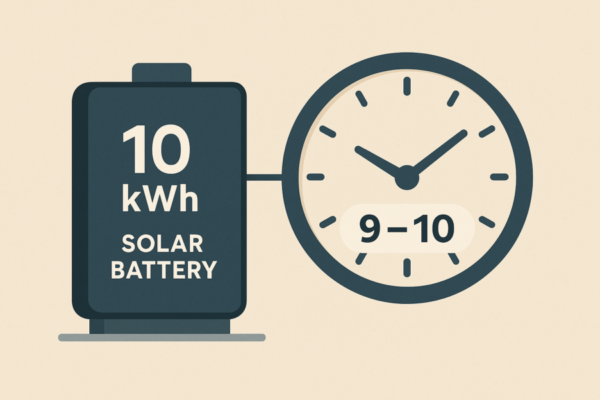
How long will a 10kWh battery last?
The answer depends entirely on:
- power consumption
- appliance usage
- inverter efficiency
- battery usable capacity
This guide explains how to estimate battery runtime accurately.
Understanding Battery Runtime
Battery runtime is calculated using:
Example Battery
A typical 48V 200Ah battery stores:
For simplicity, we will use:
- 10kWh
Runtime Examples
100W Load
Runtime:
300W Load
Runtime:
500W Load
Runtime:
1000W Load
Runtime:
2000W Load
Runtime:
5000W Load
Runtime:
Real Household Example
Daily appliances:
| Appliance | Power |
|---|---|
| Refrigerator | 150W |
| Lighting | 100W |
| Internet | 30W |
| TV | 120W |
Total:
400W
Runtime:
Air Conditioner Example
Power:
1500W
Runtime:
Whole Home Backup Example
Load:
3000W
Runtime:
Why Actual Runtime Varies
Several factors affect results.
Inverter Efficiency
Typical efficiency:
95%
Battery DOD
Most LiFePO4 batteries use:
90% usable energy.
Temperature
Extreme temperatures reduce performance.
Typical Runtime Summary
| Load | Runtime |
|---|---|
| 100W | 100 Hours |
| 500W | 20 Hours |
| 1000W | 10 Hours |
| 2000W | 5 Hours |
| 5000W | 2 Hours |
Frequently Asked Questions
Is 10kWh enough for overnight backup?
For many homes, yes.
Can a 10kWh battery power an entire house?
Depends on load demand.
How much solar is needed to recharge it?
Typically:
- 3–5kW solar array
depending on local conditions.
Conclusion
A 10kWh battery can provide anywhere from a few hours to several days of backup depending on energy consumption.
Understanding runtime calculations helps homeowners and installers size ESS systems correctly.