
Introduction
One of the most important questions from solar system users is:
How long will my lithium battery last during use?
Battery runtime depends on:
- battery capacity
- load power
- system efficiency
- depth of discharge
This guide explains how to calculate lithium battery runtime accurately.
Basic Runtime Formula
Runtime=\frac{Battery\ Capacity(Wh)}{Load\ Power(W)}}
Step 1: Convert kWh to Wh
Example:
10kWh=10000Wh
Step 2: Calculate Runtime
If load is:
1000W
Then:
10000Wh÷1000W=10 hours
Real-World Efficiency Losses
Real systems include losses:
- inverter efficiency (~90–95%)
- battery efficiency (~95%)
Actual runtime is slightly lower.
Example Real Case
A 10kWh battery:
| Load | Estimated Runtime |
|---|---|
| 500W | ~18–20 hours |
| 1000W | ~9–10 hours |
| 2000W | ~4–5 hours |
Why Runtime Is Not Linear
Battery performance varies because:
- inverter efficiency changes with load
- peak loads affect voltage
- SOC limits apply
Depth of Discharge Impact
Usable capacity:
80%−90% usable capacity
Example
A 10kWh battery:
- usable = 8–9kWh
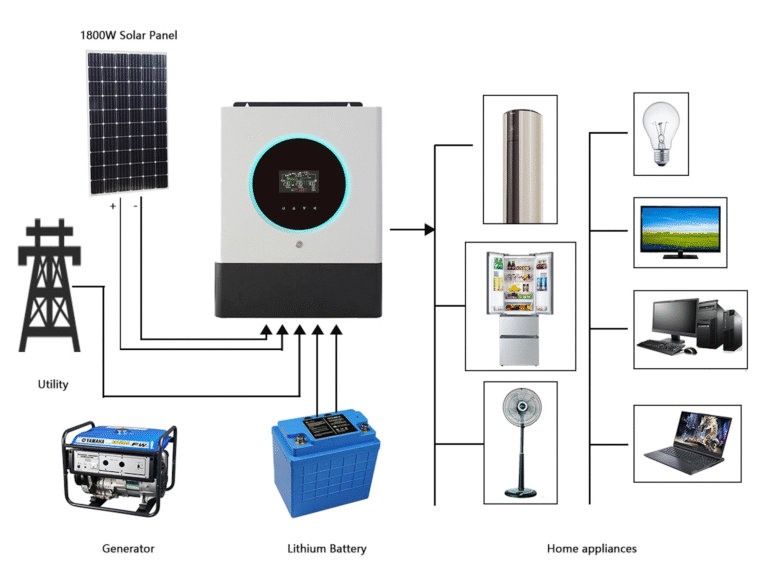
Runtime in Solar ESS Systems
In solar systems, runtime depends on:
- daytime solar charging
- nighttime discharge
- backup configuration
Telecom Application Runtime
Telecom systems often use:
- 48V 100Ah modules
- long backup duration
Common Mistakes in Runtime Calculation
Ignoring Efficiency Loss
Always include inverter losses.
Overestimating Capacity
Do not assume 100% usable energy.
Not Considering Peak Load
Peak loads reduce runtime.
Conclusion
Lithium battery runtime calculation is essential for:
- solar system design
- backup planning
- ESS sizing
Key formula:
- Capacity ÷ Load = Runtime
Real-world performance depends on efficiency and discharge limits.