
Introduction
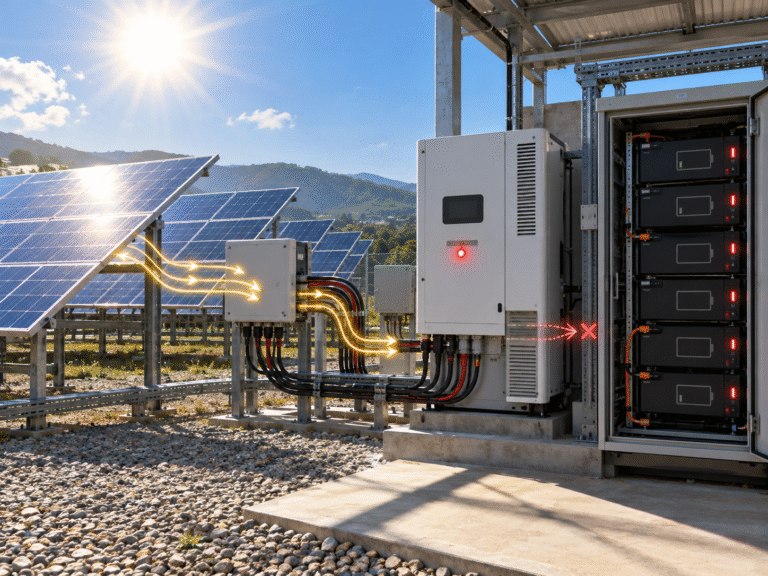
An off-grid solar system runs through the night until the LiFePO4 battery reaches low-voltage protection and shuts down. The next morning the sun is bright, the PV array is producing voltage, but the inverter display remains dark and the battery does not begin charging.
The customer is confused. If solar energy is available, why can’t the system simply start charging the empty battery?
The answer is that an ESS needs more than available sunlight. The inverter, MPPT controller, BMS and internal contactors may all require control power and a defined startup sequence before PV energy can reach the battery.
This situation is commonly related to black-start capability, low-voltage BMS shutdown and system architecture. A solar array can be producing usable voltage while the equipment needed to convert that energy remains asleep.
For off-grid projects, designing how the system recovers from a fully depleted battery is just as important as designing how it operates on a normal sunny day.
What Does Black Start Mean in an ESS?
In energy-storage terminology, black start refers broadly to the ability of a system to start from a de-energized condition without an already operating external grid.
For a small off-grid ESS, the practical question is simple: if the battery and inverter are both shut down after a deep discharge, can available solar power wake the system and begin charging automatically?
Some hybrid inverters are designed to do this. Others require battery voltage, a manual wake-up procedure or another external power source before the MPPT electronics can operate.
Black-start behavior is therefore equipment-specific.
The PV Array Can Have Voltage but No Charging Path
A multimeter across the PV string may show hundreds of volts in bright sunlight. That confirms that the panels are producing open-circuit voltage.
It does not prove that energy is flowing into the battery.
The inverter’s MPPT stage must power up, recognize acceptable PV conditions, establish its internal DC bus and enable battery charging.
If the inverter’s control electronics require a live battery before they can start, PV voltage alone may not be enough.This distinction explains many “sun is shining but battery will not charge” complaints after deep discharge.
The BMS May Have Shut the Battery Output Off
When one or more cells approach the low-voltage protection threshold, the BMS can disable discharge to protect the battery.
Depending on battery design, it may also enter a low-power sleep state. The battery terminals may show reduced or unusual voltage, or the main contactor may be open.
The inverter then sees no normal battery source and cannot complete its startup sequence. A compatible charging voltage may be required to wake the BMS.
Charge Recovery and Discharge Protection Are Different
A well-designed BMS may block further discharge while still permitting or waiting for charging recovery. This allows the battery to protect itself without becoming permanently inaccessible.
However, the external charger must be capable of presenting an acceptable charging voltage to the battery.
If the inverter itself cannot start without battery power, the system can reach a circular dependency: the battery needs the charger to wake up, while the charger needs the battery to start. Black-start design solves this dependency.
Some Inverters Have a PV Wake-Up Function
Certain hybrid inverters can power their control electronics from the PV array when sunlight is sufficient. They can then initialize the battery interface and provide a controlled recovery charge.
This allows an off-grid system to recover automatically the morning after a deep discharge. Other inverters do not support this function or support it only under specific PV-voltage conditions.
Before designing an unattended off-grid site, confirm whether the inverter can perform PV black start and under what conditions.
PV Startup Voltage Can Be Higher Than Expected
Even when the inverter supports PV wake-up, the solar array must exceed its startup requirements. Morning sunlight may produce some panel voltage but still fail to reach the inverter’s required PV startup threshold under actual load.
The system can therefore remain dark at 07:00 and suddenly wake at 09:00 as solar conditions improve. This is not necessarily a battery fault. Check the inverter’s PV startup voltage and MPPT range rather than assuming that any visible sunlight should be enough.
String Design Can Decide Whether Morning Recovery Works
Suppose a PV string operates only slightly above the inverter’s minimum startup voltage under ideal conditions. High panel temperature, shading or weak morning irradiance can make startup unreliable.
During normal operation, this may not matter because the inverter is already awake from the battery or grid. After a complete shutdown, however, PV startup becomes critical.
A string design that works adequately during normal operation may therefore perform poorly for black start. Off-grid systems should consider restart conditions as part of PV design.
AC-Coupled Solar Can Have a Different Problem
In an AC-coupled system, a standard grid-tied PV inverter may require an existing AC grid reference before it can operate. During a complete outage, anti-islanding protection keeps the PV inverter off.
If the battery inverter is also shut down because the battery reached low-voltage protection, there may be no AC microgrid for the PV inverter to synchronize with.
The sun can be shining strongly while the AC-coupled solar system produces no usable charging power. The storage inverter must first black-start the AC bus, which again requires sufficient battery or another startup source.
DC-Coupled Systems Can Be Better Suited to Solar Recovery
In a DC-coupled hybrid system, PV connects directly to the inverter’s MPPT stage. If the inverter supports PV startup without an active battery, it can potentially wake the battery directly.
This can make recovery from a deeply discharged state simpler than in some AC-coupled architectures. However, not every DC-coupled inverter offers the same black-start capability. Topology improves the possibility, but equipment behavior still needs confirmation.
The Best Solution Is Usually to Avoid Hard Shutdown
Although black-start capability is useful, the normal operating strategy should ideally prevent the battery from reaching BMS emergency undervoltage protection.
The inverter should stop supplying non-essential loads at a higher SOC or voltage threshold. This preserves enough battery energy to keep the BMS and inverter control system alive and makes morning solar recovery much easier. Using hard BMS shutdown as the normal daily low-SOC endpoint creates unnecessary recovery problems.
Reserve SOC Is an Operational Tool
An off-grid system should usually maintain some reserve rather than planning to use every last percent of displayed SOC every night.
The appropriate reserve depends on load criticality, weather uncertainty and battery configuration. For example, a site with unpredictable morning cloud cover may maintain more reserve than a system with reliable grid backup. The reserve is not “wasted battery capacity.” It provides system stability and startup margin.
Nighttime Standby Consumption Matters
Even after large loads are stopped, the inverter, BMS and communication equipment can continue consuming energy.
If the low-SOC cutoff leaves almost no reserve, these standby loads can continue reducing battery voltage overnight until the BMS eventually shuts down.
A customer may go to bed with the inverter displaying 10% SOC and wake up with a completely dark system. Low-SOC planning should include overnight standby consumption, not only the main AC loads.
Example: Battery Reaches BMS Cutoff at 4:00 a.m.
Imagine a 10kWh off-grid battery. Heavy overnight loads reduce SOC until the inverter reaches an overly low cutoff setting. The battery continues discharging and eventually the BMS opens its output at 4:00 a.m.
At sunrise, PV voltage begins increasing, but the inverter requires a valid battery connection to power its control electronics. The system remains off even though panels are producing voltage.
A technician connects an approved external charger for several minutes. The BMS wakes, inverter starts, MPPT becomes active and solar charging then proceeds normally. This indicates a startup-architecture problem, not a lack of solar capacity.
An External Recovery Charger Can Be Valuable
Remote off-grid installations sometimes benefit from a compatible external battery charger or service charger for recovery and maintenance.
If the main inverter cannot wake a deeply discharged battery, the service charger can provide a controlled initial charge. Once the BMS and inverter return to normal operation, the main solar system can take over.
The recovery charger must match the battery voltage and charging requirements. Random power supplies or unsuitable lead-acid chargers should not be used.
Generator Support Can Provide Black-Start Capability
Off-grid systems with a generator have another recovery path. The generator can provide AC input to the inverter charger, allowing the battery to recover even when PV startup is unavailable.
However, this still depends on whether the inverter can power its control electronics and accept generator input while the battery is in low-voltage shutdown.
Some systems need a specific startup sequence. Generator-backed projects should test complete recovery from a low-battery condition during commissioning rather than assuming it will work automatically.
Battery Wake-Up Voltage Matters
Some BMS designs can wake when they detect a compatible charging voltage at the terminals. Others require a physical power/reset button or an internal startup procedure.
A battery that supports charger wake-up may recover automatically when the inverter presents DC charging voltage. If the inverter cannot present that voltage until the battery is already awake, manual intervention may still be required. Battery and inverter startup logic must therefore be compatible, not just their operating voltage ranges.
Communication Can Also Be Part of Startup
A battery may wake electrically but the inverter still refuses charging because CAN communication has not initialized.
The inverter may require valid BMS data before enabling its charger. If the battery is recovering from a deep shutdown, communication startup can take longer or require the correct power-up sequence.
This is different from an ordinary communication fault during normal operation. Startup sequencing should specify which device powers on first and when communication is expected to become valid.
Parallel Battery Banks Can Recover Unevenly
Suppose four battery modules are connected in parallel and one reaches low-voltage shutdown before the others. The remaining modules may continue supporting the inverter.
Later, the offline module may need to rejoin the bank. If its voltage is substantially different from the active modules, reconnecting directly can create a large equalization current.
The BMS or master controller should manage the reconnection according to the battery manufacturer’s procedure. Do not manually force a deeply discharged module into a high-SOC parallel bank.
A Fully Depleted Bank Is More Difficult
If every battery module shuts down, the common DC bus may collapse completely. The inverter loses its reference source and the entire system enters a black state. Recovery then depends entirely on the architecture: PV wake-up, generator charging, external charger or manual battery activation.
This is why projects with many parallel modules should still maintain appropriate minimum SOC and not assume that more battery modules eliminate black-start risk.
Weather Can Turn a Black-Start Problem into a Site Outage
Suppose the battery shuts down before dawn and the next morning is heavily cloudy. Even an inverter capable of PV black start may not receive enough solar power to initialize reliably.
If the site has no grid or generator, the system can remain offline until solar conditions improve. Critical telecom, security, medical or communication sites should not rely on one uncertain recovery source. Redundancy should be considered according to the consequences of an extended outage.
Load Shedding Is Better Than Total Shutdown
A good off-grid EMS can disconnect non-critical loads before the battery reaches its final reserve. For example, air conditioning, water heating or discretionary outlets may be disabled while communication, lighting or security loads continue.
This extends critical runtime and helps keep the battery and inverter alive until solar returns. Load prioritization can often improve reliability more effectively than simply increasing battery capacity.
Why a Bigger Battery Does Not Automatically Fix Black Start
More battery capacity reduces the likelihood of deep discharge, but it does not change the startup architecture. If a larger battery is still eventually drained below BMS cutoff, the same inability to wake from PV can remain.
The project should address both energy sizing and restart behavior. Battery kWh answers “how long can the site run?” Black-start design answers “how does it recover if everything eventually turns off?”
Commissioning Should Include a Controlled Low-SOC Test
Most installations are commissioned when batteries are nearly full. The system powers on successfully, solar charges and everything appears normal. That test does not prove that the system can recover after a deep discharge.
For critical off-grid projects, perform a manufacturer-approved controlled test that verifies low-SOC shutdown, charger wake-up, PV or generator recovery and normal restart. Do not deliberately force cells into unsafe undervoltage. The test should remain within the approved system procedure.
What Data to Collect When the System Will Not Wake
If the sun is available but charging will not start, record battery-terminal voltage, BMS status, PV open-circuit voltage, inverter PV startup requirement, inverter display/LED status and any generator or grid availability. Also determine whether the BMS can be activated manually or by an approved charger.
These observations help separate four different possibilities: battery still asleep, inverter unable to black start, PV below startup conditions or communication/startup sequence failure.
For Distributors and EPC Contractors
Before supplying batteries for a fully off-grid project, ask the inverter supplier several specific questions: Can the inverter start from PV with the battery in low-voltage shutdown? What is the minimum PV startup condition? Can an external generator wake the charger? Does the battery need to be manually activated? What minimum battery voltage is required for inverter startup?
These questions are far more useful than simply asking whether the inverter “supports LiFePO4.” Compatibility includes abnormal and recovery states, not only normal daily operation.
Conclusion
Bright sunlight does not guarantee that a deeply discharged solar ESS can restart automatically. After BMS low-voltage shutdown, the inverter, MPPT and battery may all be waiting for another part of the system to wake first.
Reliable recovery depends on black-start capability, PV startup voltage, BMS wake-up logic, inverter control power and system architecture.
The best design also avoids reaching hard BMS shutdown during normal operation by maintaining appropriate reserve SOC and shedding non-essential loads before the battery is completely depleted.
HIZN supplies LiFePO4 batteries for residential, telecom and off-grid energy storage systems with BMS protection and communication options.
If you are designing an off-grid project, send us the battery capacity, inverter model, PV configuration, minimum SOC strategy and available generator/grid backup. We can help identify the battery-side startup and charging conditions that should be confirmed before deployment.