
Introduction
One of the biggest sources of confusion for first-time battery buyers is battery capacity.
A customer comparing two batteries may see the following specifications:
- 12.8V 100Ah
- 25.6V 100Ah
- 48V 100Ah
- 51.2V 100Ah
At first glance, all four batteries appear to have the same 100Ah capacity.
Many buyers naturally assume they store the same amount of energy.
They do not.
In reality, these batteries contain dramatically different amounts of usable energy because voltage is equally important.
Understanding battery capacity is essential for:
- Selecting the correct battery size
- Comparing different battery models
- Designing solar energy storage systems
- Calculating backup time
- Estimating return on investment
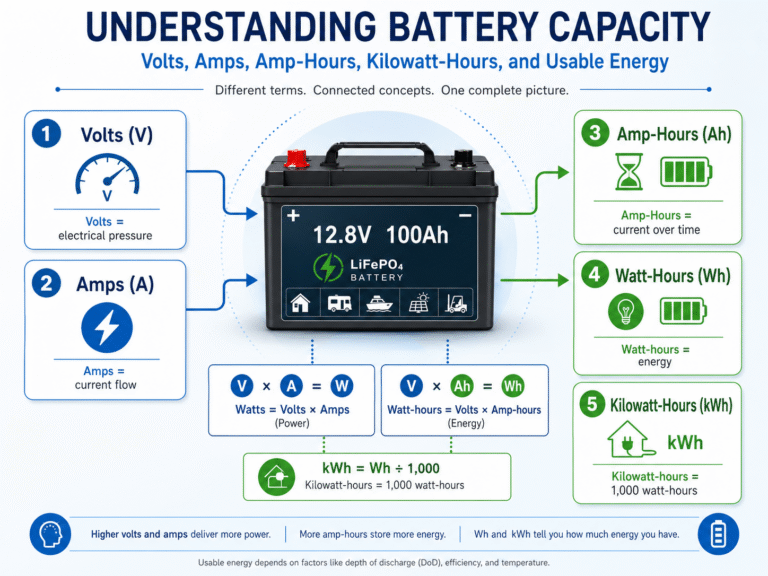
This chapter explains the relationship between voltage, current, amp-hours, watts, watt-hours, and kilowatt-hours using practical engineering examples.
Why Battery Capacity Is Often Misunderstood
Many battery advertisements highlight only the Ah (Amp-Hour) rating.
Examples include:
- 100Ah
- 200Ah
- 280Ah
- 314Ah
While Amp-Hours are important, they do not tell the whole story.
Consider these two batteries:
Battery A
- 12.8V
- 100Ah
Battery B
- 51.2V
- 100Ah
Both batteries have the same Ah rating.
However, Battery B stores four times as much energy.
The missing variable is voltage.
What Is Voltage?
Voltage can be thought of as the electrical “pressure” that pushes current through a circuit.
An easy analogy is a water system.
Imagine two water tanks connected to separate hoses.
Both tanks hold the same amount of water.
However, one tank is positioned much higher.
Because of its greater height, the water leaves the hose with more pressure.
Voltage behaves similarly.
Higher voltage allows electrical energy to be delivered more efficiently, especially over longer distances and at higher power levels.
For this reason, residential ESS systems commonly use:
- 48V
- 51.2V
rather than lower-voltage battery configurations.
Common Battery Voltages
Different applications use different nominal voltages.
| Nominal Voltage | Typical Application |
|---|---|
| 12.8V | RV, Marine, Small Solar Systems |
| 25.6V | Medium Off-Grid Systems |
| 48V | Telecom Backup |
| 51.2V | Residential ESS |
| High Voltage (100V–800V+) | Commercial & Utility BESS |
Higher-voltage systems generally reduce current for the same power output, helping to minimize cable losses and improve system efficiency.
What Is Current?
Current represents the flow of electrical charge through a conductor.
It is measured in Amperes (A).
Returning to the water analogy:
- Voltage is water pressure.
- Current is the amount of water flowing through the pipe.
A larger current means more electrical energy is being transferred each second.
What Is an Amp-Hour (Ah)?
Amp-Hour measures electrical charge storage.
It indicates how much current a battery can theoretically deliver over a period of time.
For example:
A battery rated at:
100Ah
may theoretically provide:
- 100A for 1 hour
- 50A for 2 hours
- 20A for 5 hours
- 10A for 10 hours
under specified test conditions.
It is important to remember that actual runtime depends on factors such as temperature, discharge rate, and battery management.
Why Ah Alone Can Be Misleading
Suppose you compare the following batteries:
| Battery | Voltage | Capacity |
| Battery A | 12.8V | 100Ah |
| Battery B | 25.6V | 100Ah |
| Battery C | 51.2V | 100Ah |
If you look only at the Ah rating, all three batteries appear identical.
However, the amount of stored energy is very different because voltage changes.
This is why professional ESS engineers rarely compare batteries using Ah alone.
Instead, they compare energy, measured in kilowatt-hours (kWh).
What Is Power?
Power describes how quickly electrical energy is used or delivered.
It is measured in:
Watts (W)
or
Kilowatts (kW).
One kilowatt equals:
Examples:
- LED light: 10W
- Laptop: 65W
- Refrigerator: 150–300W
- Microwave: 1200W
- Air Conditioner: 1500–3000W
- Electric Vehicle Charger: 7000W+
Power tells us how fast energy is being consumed—not how much energy is stored.
What Is Energy?
Energy combines power and time.
It is measured in:
- Watt-hours (Wh)
- Kilowatt-hours (kWh)
The relationship is:
Examples:
A 100W light operating for:
10 hours
uses:
This is why utility companies charge customers based on kWh, not Ah.
The Most Important Battery Formula
For energy storage systems, the single most important calculation is:
This equation allows buyers to compare batteries of different voltages on an equal basis.
Practical Example 1
Battery:
12.8V
100Ah
Energy:
Practical Example 2
Battery:
25.6V
100Ah
Energy:
Practical Example 3
Battery:
51.2V
100Ah
Energy:
Practical Example 4
Battery:
51.2V
200Ah
Energy:
Practical Example 5
Battery:
51.2V
314Ah
Energy:
Why ESS Manufacturers Use kWh Instead of Ah
Residential and commercial energy storage systems are designed to store and deliver energy—not simply electrical charge.
For this reason, battery capacity is increasingly expressed in:
- 5kWh
- 10kWh
- 15kWh
- 20kWh
- 30kWh
- 50kWh
rather than only Amp-Hours.
This approach makes it easier for homeowners, installers, and project developers to compare products and estimate backup performance.
Engineering Insight
One of the most common mistakes in battery procurement is comparing batteries based solely on their Ah rating.
For example, a distributor may receive quotations for two “100Ah batteries” and assume they are equivalent.
Without considering voltage, usable energy, depth of discharge, and efficiency, such comparisons can be misleading.
Professional battery evaluation should always begin with usable energy (kWh), followed by an assessment of system efficiency, expected cycle life, warranty terms, and application requirements.
Chapter Summary (Part 1)
Understanding battery capacity begins with recognizing the relationship between:
- Voltage
- Current
- Amp-Hours
- Power
- Energy
Among these, kWh is the most meaningful unit for comparing energy storage systems because it directly represents the amount of usable electrical energy available.
In Part 2, we will explore:
- Usable Energy vs Rated Capacity
- Depth of Discharge (DOD)
- Round-Trip Efficiency
- Why two 10kWh batteries may not deliver the same runtime
- How professional engineers calculate real usable battery capacity